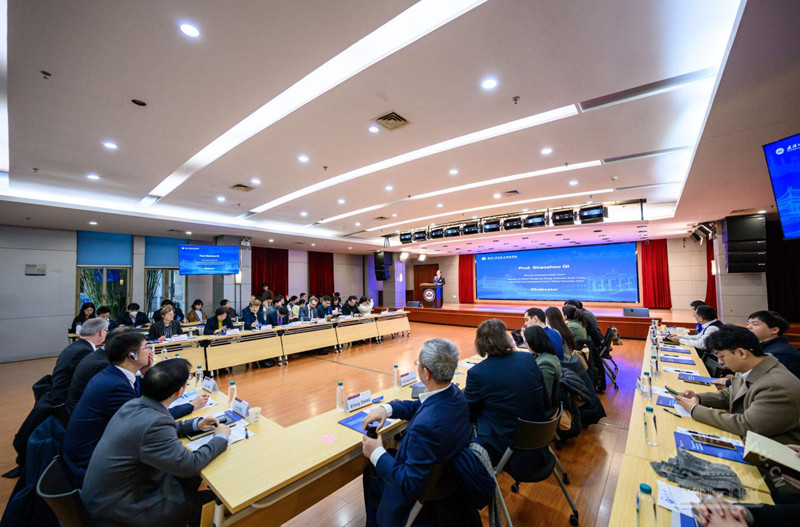
A conference on carbon market innovation and industrial transformation in the AI Era is held on Dec 15 at Wuhan University.
Wuhan University hosted a seminar on carbon market innovation and industrial transformation in the AI Era on Dec 15, attracting experts and scholars from Chinese and German universities, including Heidelberg University, Tsinghua University, and the University of Hong Kong.
Andreas Loschel, a professor from Ruhr University Bochum, emphasized that future energy systems will rely on renewable energy, with AI playing a crucial role in enhancing efficiency and flexibility.
He advocated for price-based policies over command-and-control approaches to address electricity price volatility.
Zhang Xiliang, a professor from Tsinghua University, highlighted that expanding the coverage of the Emissions Trading System (ETS) and introducing quota auctions could reduce emission reduction costs, suggesting future policies should focus on improving market efficiency.
Veronika Grimm, a professor from the University of Erlangen-Nuremberg, discussed the global challenges of industrial decarbonization, innovation growth, and climate cooperation.
She pointed out that AI is a driving force for Europe's economic recovery but stressed the need for regulatory risk management and international cooperation.
Zhang Xiaoling, a professor from the University of Hong Kong, reviewed AI applications in environmental monitoring and energy optimization, proposing a digital twin platform framework for net-zero cities and emphasizing the importance of data governance and technology policy coordination.
Anja Senz, a professor from Heidelberg University, explored AI ethics issues, such as fairness and data protection, calling for sustainability to be integrated into governance, and introduced the EU's risk-based regulatory framework.
The seminar also featured a youth teacher salon and a doctoral student roundtable, where young scholars discussed carbon market innovation directions, domestic and international ETS experiences, and AI integration.
 中文
中文