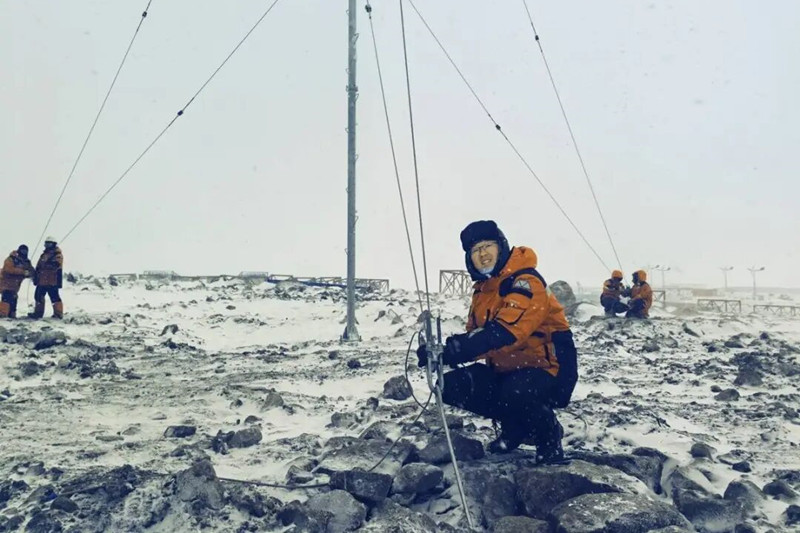
Yu Liang works at Qinling Station.
China’s 42nd Antarctic expedition, which took place from Nov 1, 2025 to April 9, 2026, featured a team of five members from Wuhan University, who were stationed at the Great Wall, Zhongshan, and Qinling research stations.
At Great Wall Station, Professor Pang Xiaoping, Associate Researcher Zang Lin, and Postdoctoral Fellow Liu Mingliang conducted their research, while Research Assistant Hu Changhong was based at Zhongshan Station, while Research Assistant Yu Liang took on pivotal tasks at Qinling Station.
The team brought back a trove of valuable data, including high-resolution drone imagery and observations of oceanic waves and currents, along with fresh insights into Antarctic conditions.
Yu and his team played a crucial role in setting up the laboratory at Qinling Station, deploying advanced equipment to monitor oceanic environmental factors such as wind, waves, and currents.
They are currently engaged in cutting-edge research on high-frequency radio wave scattering mechanisms under high wind conditions, providing essential support for scientific operations at the station.
Zang's team focused on testing satellite navigation performance and maintaining equipment. Through precise testing and system upgrades of GNSS equipment, they ensured the accuracy of positioning data in the challenging polar environment, offering vital support for evaluating the performance of China's BeiDou system in high-latitude regions.
They also utilized drone remote sensing imagery to document vegetation growth and penguin breeding conditions. This comprehensive data, covering both navigation benchmarks and ecological monitoring, will serve as a crucial reference for Antarctic navigation safety and resource conservation.
For Professor Pang, this expedition marked her third visit to Antarctica, 25 years after her last. She noted that changes in the polar environment pose new challenges for China's polar management and peaceful use – core focuses of the expedition.
The rise of Antarctic tourism was another significant change observed by the team. Great Wall Station, the only Chinese station open to tourists, features a museum showcasing the history of polar exploration and equipment evolution, as well as a greenhouse with hydroponic vegetables, intriguing many visitors.
The university is also expanding its reach beyond the natural sciences to include the humanities and social sciences, aiming to cultivate polar talent with a global perspective.
 中文
中文