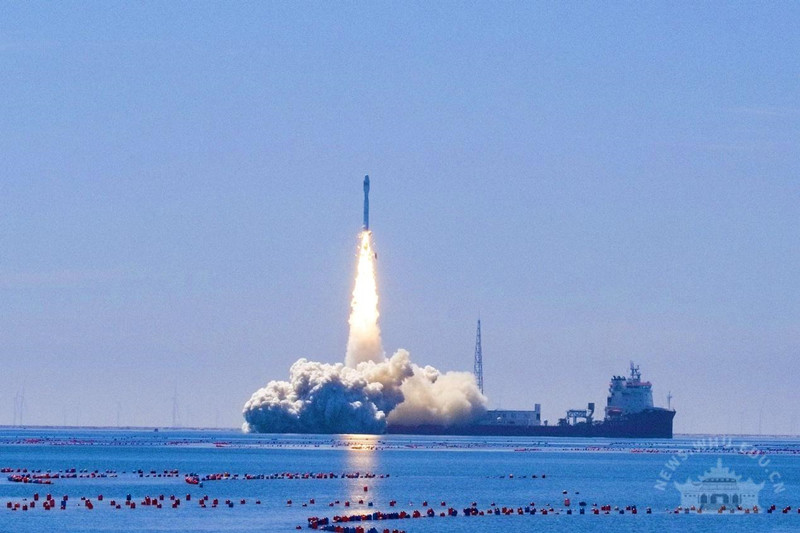
The Smart Dragon-3 Y12 carrier rocket is launched off the coast of Haiyang on Aug 5, deploying Wuhan University's hyperspectral satellites into their designated orbits.
The Smart Dragon-3 Y12 carrier rocket was launched off the coast of Haiyang, a county-level city in Yantai, Shandong province, on Aug 5, deploying Wuhan University (WHU)'s hyperspectral satellites into their designated orbits.
The launch was witnessed by prominent figures, including Zhu Kongjun, Party secretary of WHU, and academicians Li Deren and Gong Jianya from the Chinese Academy of Engineering and the Chinese Academy of Sciences .
The satellites, named Hyperspectral 01 and 02, are part of the Oriental Smart Eye Constellation, a collaborative effort led by WHU and Haiyang Oriental Spaceport. Li serves as the chief scientist, with Professor Wang Mi from WHU's State Key Laboratory of Information Engineering in Surveying, Mapping, and Remote Sensing as the chief designer.
These satellites feature advanced core specifications, including a 22-band hyperspectral payload, a spatial resolution of 5 meters, and a swath width of 300 kilometers. Remarkably lightweight, each satellite weighs approximately 300 kilograms — only one-fifth the weight of comparable Western satellites — and operates in an orbit approximately 786 kilometers above Earth.
This launch represents a significant milestone in the development of the first phase of the Oriental Smart Eye Constellation's "1+2" demonstration service system, aiming to achieve high-precision monitoring within China and consistent macro-monitoring of land and sea areas around the globe.
The 2026 OSE Constellation Development Symposium was also held, gathering over 500 participants, including academicians, experts, and enterprise representatives, to discuss the high-quality development of commercial aerospace.
Li highlighted the unique features and applications of the hyperspectral satellites, emphasizing their role as a major breakthrough in China's hyperspectral remote sensing technology and embodying the development philosophy that "lucid waters and lush mountains are invaluable assets".
The Open Earth Engine OGE2.0 was also unveiled, featuring innovations in resource sharing, algorithm expansion, model adjustment, task scheduling, and zero-threshold intelligent agents.
WHU and the Yantai government signed a cooperation agreement in 2024 to establish the Oriental Maritime Space Port Research Institute, with the OSE Constellation a core part of this collaboration, aiming to develop a real-time intelligent aerospace information service system that integrates communication, navigation, remote sensing, and computation.
 中文
中文