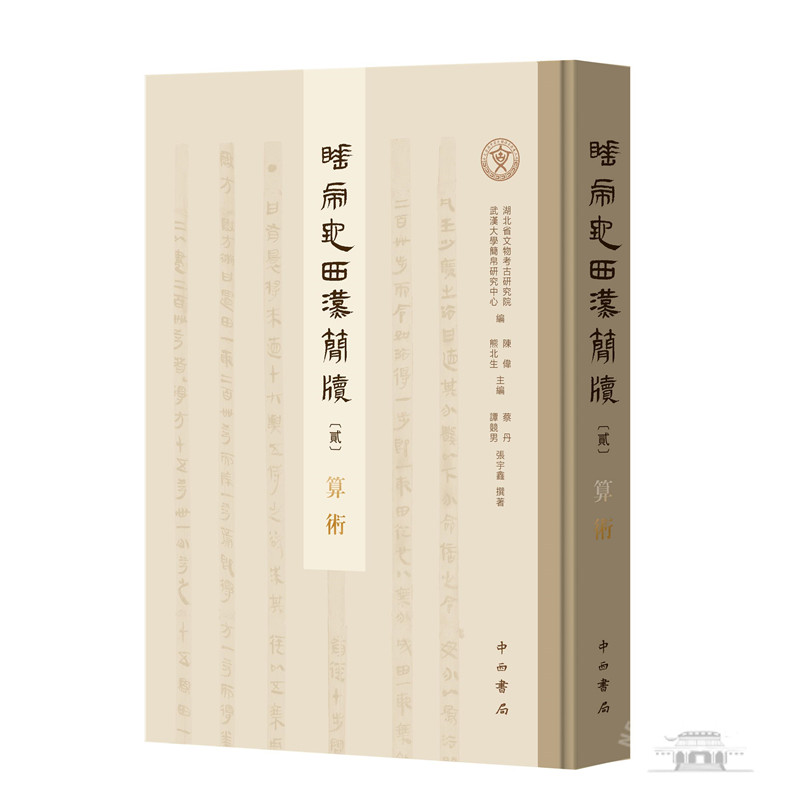
Book cover of Arithmetic.
Wuhan University’s bamboo and silk research center, in collaboration with the Hubei Provincial Institute of Cultural Relics and Archaeology, has edited and published the second volume of the "Shuihudi Han Bamboo Slips" series, titled Arithmetic, through Zhongxi Book Company.
These bamboo slips were unearthed in November 2006 from Tomb No 77 at the Shuihudi site in Yunmeng county, Xiaogan, Hubei province. Dating back to the Western Han Dynasty (206 BC-AD 24), the collection comprises over 2,000 slips.
The bamboo slips offer profound insights into the study of Qin (221-206 BC) and Han (206 BC-220) dynasties, particularly regarding politics, economy, law, and science during the early Western Han period.
Arithmetic includes 216 bamboo slips, featuring both full-size and enlarged color plates with transcriptions and annotations. The arithmetic problems cover a wide range of topics, including calculations of land area, volume, grain conversion, proportional distribution, and square root extraction.
The content suggests that Arithmetic may have been a copy or an extract, serving as a reference manual for the tomb owner, a low-level official involved in tasks such as household registration, taxation, land measurement, and infrastructure projects.
The "Arithmetic" bamboo slips represent the best-preserved early mathematical documentation uncovered through scientific archaeological excavation to date. The problem-solving approaches are rigorous and clear, with concise and efficient calculation methods that are highly practical.
This work highlights the meticulous scientific spirit of the ancients and showcases a mature paradigm for using mathematics to address various real-world problems, demonstrating both scientific and practical significance.
The algorithms and numerical values related to fraction operations, square root extraction, and calculations of Pi exemplify the remarkable achievements of ancient Chinese mathematics.
The bamboo slips also depict the era’s diverse social settings, ranging from everyday grain exchanges and the fair division of wine expenses to large-scale state undertakings such as land measurement, tax collection, and engineering projects.
 中文
中文