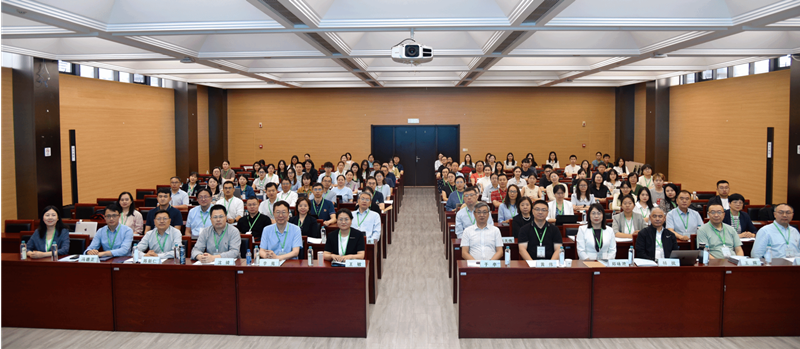
A symposium on language governance in the digital age was recently held at Wuhan University, bringing together over 120 experts and scholars from more than 70 universities and research institutions worldwide.
Discussions focused on the profound impact of digital intelligence technologies, such as AI, big data, and platform communication, on language life, language policy, and language governance.
Academician Li Wei from University College London explored the social transformations of humanity in the post-AI era from a philosophical and anthropological perspective, proposing four pillars of human sociality in this new age: the return to animality, the source of intrinsic intention, the bearer of risks and consequences, and the creation of meaning within constraints.
Wang Min, a researcher from the Institute of Applied Linguistics of the Ministry of Education, elaborated that the national language survey should encompass five dimensions: language positioning and function, development trends, needs and services, technological support, and governance assurance.
Professor Feng Dezheng from Hong Kong Polytechnic University said that governance communication in the digital age is increasingly platform-based, visual, and emotional, emphasizing that language governance must evolve into multimodal discourse governance.
Experts and scholars also exchanged ideas on core topics and cutting-edge areas of current language governance research, including language governance theory, global language governance, and regional and national language governance.
Chief editors of prestigious journals discussed with participants, exploring academic publishing and discipline development in language governance research.
A research methods workshop was also held, during which tools for measuring lexical complexity in modern and ancient Chinese texts, as well as for multimodal discourse governance, were provided.
 中文
中文