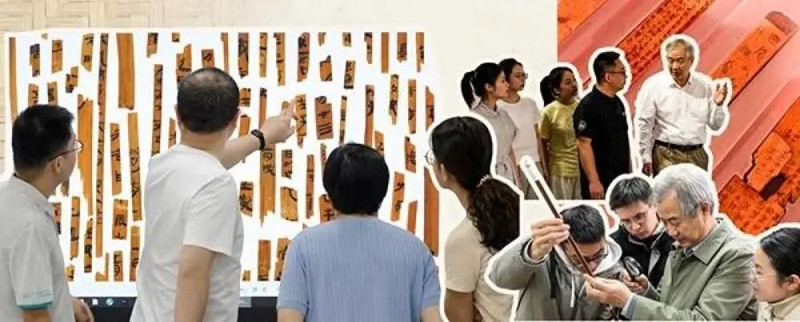
The bamboo and wooden slips team at Wuhan University.
A team of researchers at Wuhan University is breathing new life into ancient Chinese history by exploring bamboo and wooden slips — traditional Chinese writing materials — to unearth the rich tapestry of China's past.
These slips, some over 2,000 years old, served as the primary medium for writing long before paper became widespread. Among these artifacts is a remarkable find: a multiplication table from the Qin Dynasty (221-206 BC), unearthed in Hunan province.
This table reveals early concepts of fractions and underscores the significance of mathematical education in ancient China.
Turning these archaeological finds into historical documents is complex, as scholars must decipher ancient scripts, often working with fragmented and decayed materials, including character recognition, sentence parsing, and reassembling the slips into coherent texts.
The team, consisting of 51 teachers and graduate students from diverse fields such as history, Chinese literature, and archaeology, shares a passion for this meticulous work. For them, each slip is a crucial piece of China’s vast historical narrative.
One of the team's major projects involves Qin and Han (206 BC-AD 220) Dynasty bamboo slips from the Shuihudi site in Yunmeng county, Hubei province, which is renowned for its comprehensive legal documents, as they face the daunting challenge of reconstructing 9,456 fragments.
The team is also dedicated to making these ancient texts accessible and engaging to the public by hosting exhibitions and educational programs to bridge the gap between academic research and cultural heritage appreciation.
 中文
中文