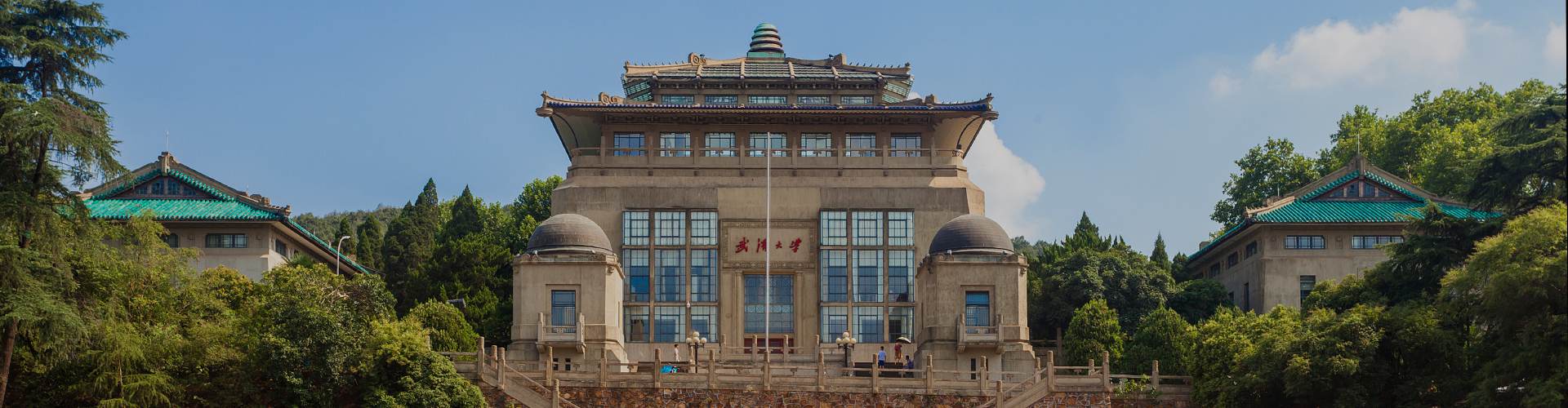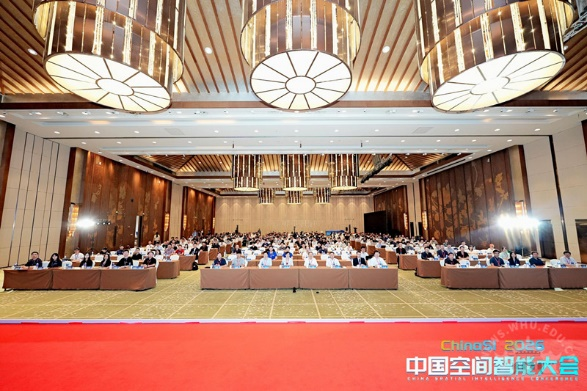
ChinaSI 2026 opens in Wuhan on Aug 28.
Wuhan University cohosted the China Spatial Intelligence Conference (ChinaSI 2026) from Aug 28 to 30, bringing together more than 800 representatives from over 160 universities, research institutes, and enterprises.
The conference featured four speeches, three talks, and seven forums. It also organized two workshops alongside exchange and exhibition activities, focusing on the latest research progress and innovative achievements in spatial intelligence.
Professor Li Deren, an academician of the Chinese Academy of Sciences and the Chinese Academy of Engineering, delivered a report to discuss the trend of AI transitioning from the information world to the physical world.
It highlighted applications of spatiotemporal intelligence in aerospace detection, navigation, unmanned systems, environmental monitoring, and socio-economic analysis, and envisioned the integrated development of perception, positioning, cognition, and decision-making.
Professor Tan Ping from the Hong Kong University of Science and Technology presented a keynote exploring the role of 3D geometric constraints in scene reconstruction and generation.
Meanwhile, Professor Ji Xiangyang from Tsinghua University discussed advancements in target positioning, scene reconstruction, and spatial interaction.
The conference also organized a series of forums, workshops, competitions, exhibitions, and scholar interactions around cutting-edge directions in spatial intelligence, promoting exchanges and cooperation between basic research, key technologies, and industrial applications.
 中文
中文