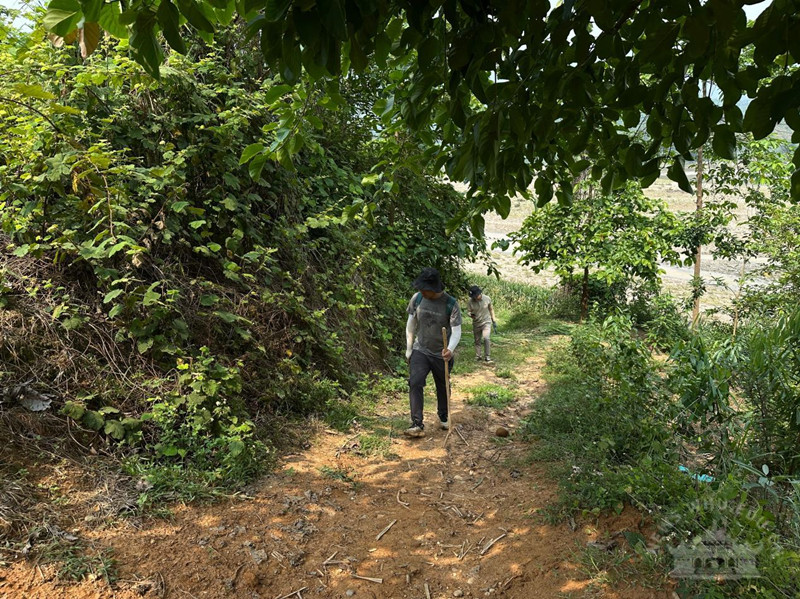
Team members conduct a survey of the Honghe River Basin in Lao Cai province, Vietnam.
New findings of an archaeology project involving Wuhan University (WHU), the Hubei Provincial Institute of Cultural Relics and Archaeology, and the Vietnam National University, Hanoi, have been released to celebrate the upcoming 50th anniversary of WHU’s archaeology department.
These institutions signed a cooperative framework agreement in September 2024 and conducted a specialized field survey in the Honghe River Basin of Lao Cai Province, Vietnam in May 2025, identifying 54 prehistoric sites.
They received an excavation license from the Vietnamese Ministry of Culture and Tourism in June, allowing them to conduct systematic excavations at the Ngòi Nhù site on a secondary terrace of the Honghe River from October to December.
The analysis of the unearthed artifacts, stratigraphy, geomorphology, and dating reveals that from 10,000 to about 3,000 years ago, the area was home to a distinctive chipped stone tool industry, which later evolved to include ground stone tools and pottery.
The findings indicate significant interaction and exchange with surrounding cultural groups. Ongoing scientific analyses of chronology, environment, stone tools, pottery, and plant remains continue to provide insights.
Professor Li Yinghua's team from WHU has been conducting prehistoric site surveys and trial excavations in the Honghe River Basin of Yunnan province since the end of 2024, aiming to further explore the interaction and exchange of cultural technologies along the transnational Yuanjiang-Honghe River.
The project seeks to provide substantial evidence of the cultural and technological exchanges during the Paleolithic-Neolithic transition between South China and Southeast Asia, highlighting the region's cultural diversity and complexity.
 中文