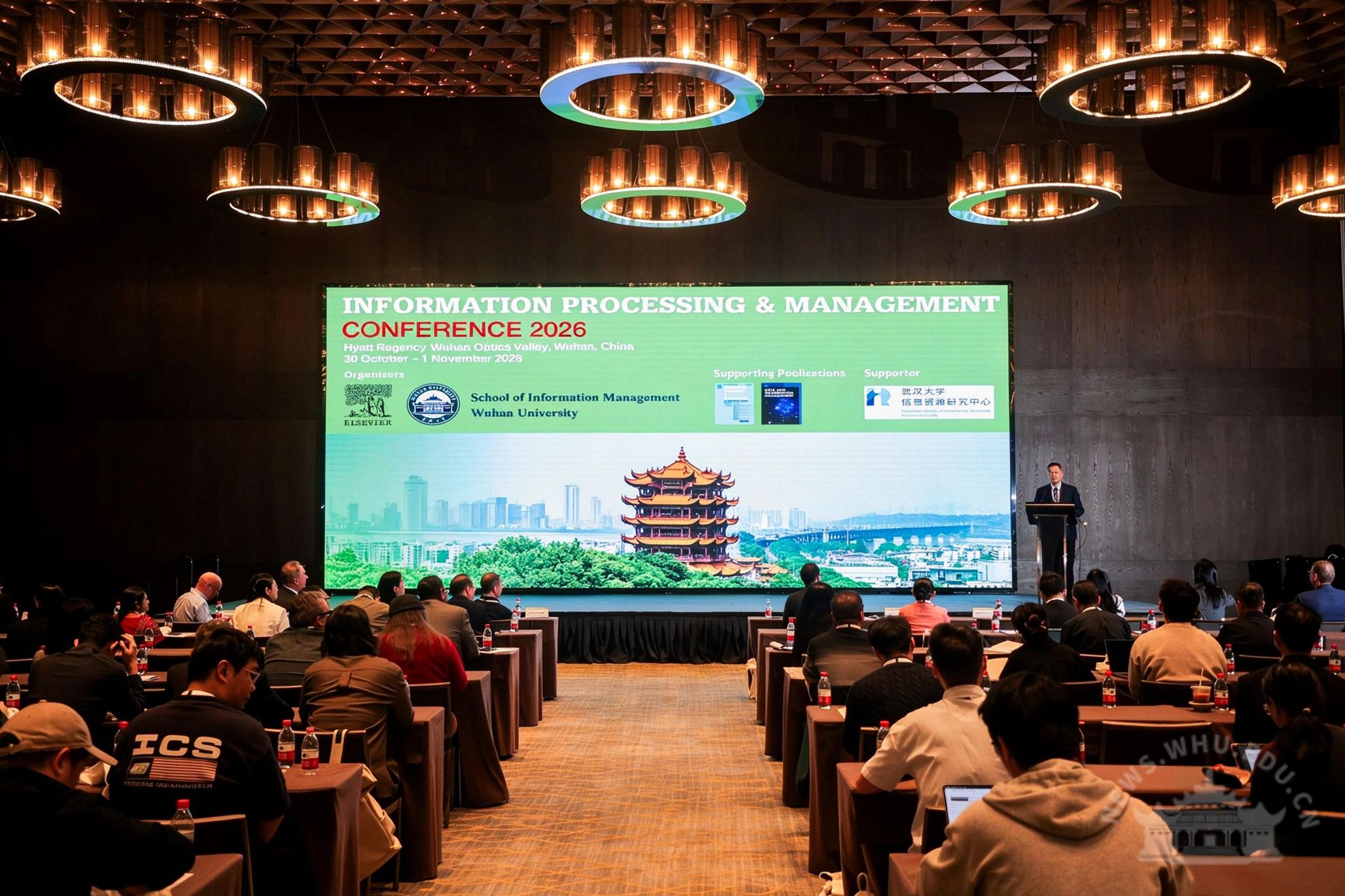
Nearly 400 scholars from more than 30 countries gathered in Wuhan from Oct 30 to Nov 1 for the Information Processing & Management Conference 2026 (IP&MC 2026), exploring how AI and large language models (LLMs) are reshaping information science.
The conference, themed "From documents to dialogues, from retrieval to reasoning: Reimagining computational information science in the age of AI and LLMs", was jointly organized by Elsevier and Wuhan University (WHU)'s School of Information Management and brought together experts in information resource management, AI, and data science.
Keynote speakers examined how emerging technologies affect information retrieval, user privacy, and human-AI interaction. Fabio Crestani, a professor at Universita della Svizzera italiana in Switzerland, said future search systems should better understand users' characteristics and psychological states while ensuring personalized and fair results.
Hua Pang, a professor at Tianjin University, discussed users' privacy perceptions and behaviors when interacting with generative AI, highlighting differences between ChatGPT and DeepSeek. Matthew K.O. Lee, a professor at Hong Kong Metropolitan University, warned that relationship-oriented AI could foster user dependence and called for designs that balance emotional support with safeguards against overreliance. Fiona Fui-Hoon Nah, a professor at Singapore Management University, presented a global dynamic flow model to inform the development of adaptive human-AI interaction systems.
The conference also introduced a new mechanism linking academic conferences with journal publishing to help disseminate research findings. Participants emphasized interdisciplinary collaboration and a human-centered approach to AI development.
 中文