A research team from Wuhan University (WHU) has identified a new mechanism governing zinc crystallization in aqueous zinc-ion batteries, offering a more accurate way to predict crystal growth and new insights into designing longer-lasting energy storage systems.
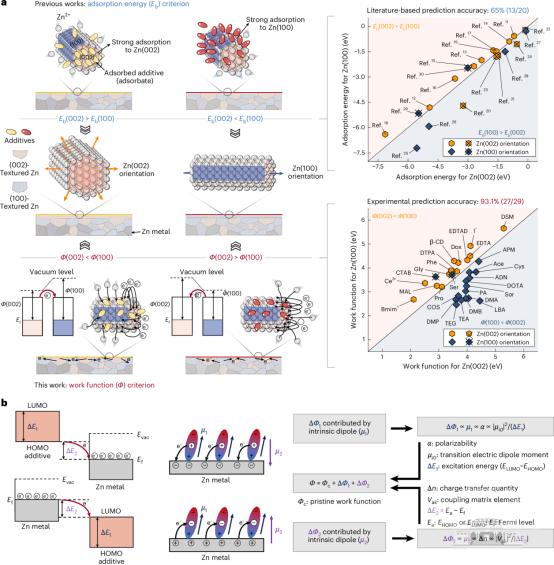
The study, published online in Nature Chemistry, was led by researchers Chen Chaoji and Yu Le, with Wang Sijun and Yu as co-first authors. The work was supported by the National Natural Science Foundation of China. The study found that the relative work functions of zinc crystal facets after molecular adsorption can predict the preferred orientation of zinc electrocrystallization, achieving 93.1 percent accuracy across 29 additives with different chemical structures. This significantly outperforms the traditional adsorption-energy model, which achieved 65 percent accuracy.
The findings also challenge the conventional view that the Zn (002) orientation is the best choice for practical zinc anodes. Electrochemical tests showed that Zn (100)-oriented zinc anodes maintained stable cycling for more than 5,000 hours at low current densities. Under demanding conditions, including a current density of 20 mA per square centimeter and a depth of discharge exceeding 85 percent, they also delivered better cycle life and Coulombic efficiency than their Zn (002)-oriented counterparts.
The researchers found that selective adsorption of electrolyte additives on different zinc facets triggers surface electron redistribution, changing their local dipoles and work functions. This process determines the preferred growth orientation. They also identified a strong correlation between additives' HOMO-LUMO gaps and work-function changes, providing a molecular descriptor for rapid additive screening.
 中文