Professor Min Jie’s team at the Institute for Advanced Studies, Wuhan University, has made a significant breakthrough in the development of solution-processed high-efficiency all-small-molecule solar cells.
By employing a modular design strategy, the team synthesized small molecule donor materials with asymmetric side chain structures, effectively controlling intermolecular interactions, crystallization behavior, and the morphology of the active layer.
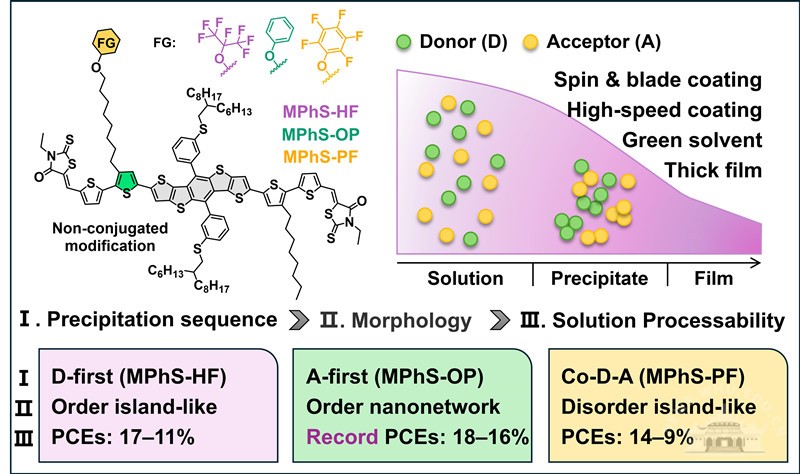
This innovative approach has resulted in a record-breaking power conversion efficiency (PCE) of 18.12 percent for all-small-molecule systems, showcasing excellent processability and significant potential for large-scale production.
The research findings, Controlled-Disorder Asymmetrical Donors Enable Efficient All-Small-Molecule Solar Cells with Excellent Solution-Processability, have been published in the prestigious journal Angewandte Chemie International Edition.
The team synthesized three asymmetric small molecule donor materials with diverse side chain functional groups: MPhS-HF, MPhS-OP, and MPhS-PF. Their comprehensive study of these materials' photoelectric properties, solution behavior, crystallization dynamics, and device performance revealed that MPhS-OP, which incorporates alkoxyphenyl side chains, demonstrates exceptional compatibility and delayed crystallization when combined with the non-fullerene acceptor L8-BO.
This compatibility facilitated the formation of a nanoscale interpenetrating network morphology, which enhances efficient exciton dissociation, balanced charge transport, and reduced recombination losses.
The team also discovered the kinetic mechanism behind the delayed crystallization during the film formation of MPhS-OP, effectively preventing premature phase separation and ensuring consistent microstructural morphology across various processing conditions.
 中文
中文