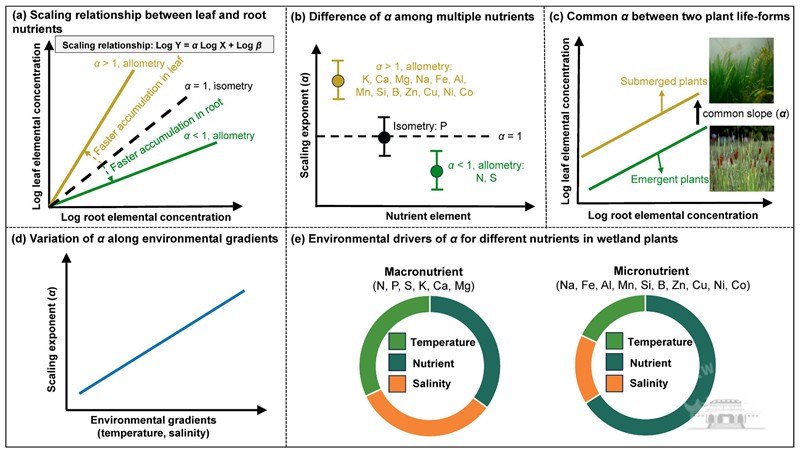
The conceptual framework for nutrient allocation patterns between leaves and roots in wetland plants.
Wang Zhong, an associate professor from Wuhan University's College of Life Sciences, has published groundbreaking research in the British Ecological Society's journal Functional Ecology.
The study, titled Conservatism and plasticity of multiple nutrient allocation in wetland plants: Insights from allometric scaling, offers new insights into nutrient allocation strategies in wetland plants.
The research team conducted an extensive survey of wetland plant communities across the Qinghai-Tibet Plateau and the arid regions of Northwest China. They collected samples from 113 sites, including plant, soil, and water samples, building a comprehensive multi-element dataset spanning from community to multi-organ levels.
By analyzing the allometric relationships of 16 elements between leaves and roots, the study revealed patterns of elemental distribution among plant organs across different life forms and phylogenetic levels. The research also examined how these patterns respond to factors like salinity, temperature, and environmental nutrients.
The findings show that water salinity, temperature, and the nutrient content of soil and water influence the elemental allocation strategies between plant leaves and roots. As salinity and temperature increase, the accumulation rate of most nutrients in leaves surpasses that in roots.
The discovery highlights the conservatism and plasticity of nutrient allocation in wetland plants from an allometric scaling perspective. It suggests that, in the context of global change, increasing salinization, climate warming, and nutrient heterogeneity may further alter the nutrient distribution strategies of wetland plants.
 中文
中文