Tumors promote lung fibrosis and aging by secreting DDAH1 protein.
A study led by Professor Yan Wei and his team from the College of Life Sciences at Wuhan University has uncovered a novel mechanism by which tumors promote lung aging and fibrosis.
The study, titled Cancer-cell-secreted DDAH1 induces TGF-β1/Smad3 signaling pathway to promote fibrosis and aging in lung, was recently published in the journal Nature Aging.
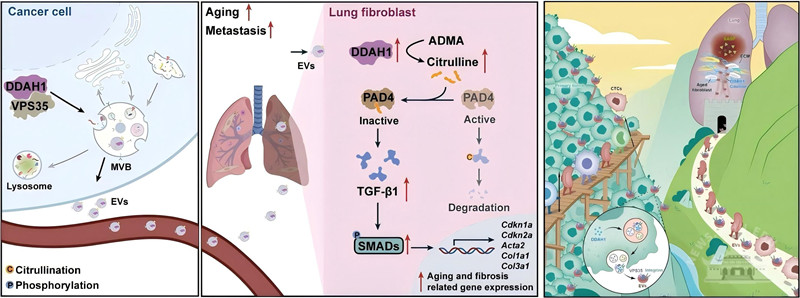
The research highlights how tumors secrete small extracellular vesicles (sEVs) rich in dimethylarginine dimethylaminohydrolase 1 (DDAH1). These vesicles are absorbed by lung fibroblasts, causing citrulline buildup, which subsequently triggers lung aging and fibrosis.
The study demonstrated that mice exposed to tumor-secreted sEVs exhibited classic signs of lung aging. However, when the key gene RAB27A — responsible for sEV secretion — was knocked down in tumor cells, their ability to induce lung aging significantly diminished.
The team identified, through comprehensive proteomic analysis of tumor sEVs and single-cell sequencing of lung tissues, that DDAH1 carried by these vesicles induces fibroblast aging in the lungs.
DDAH1's catalytic product, citrulline, was found to inhibit TGF-β1 citrullination mediated by peptidylarginine deiminase 4. This inhibition activates the TGF-β1/Smad3 signaling pathway in lung fibroblasts, leading to lung aging and fibrosis. Notably, the use of a small molecule inhibitor of DDAH1, PD 404182, reduced the degree of lung fibrosis and improved aging-related phenotypes.
In breast cancer patient samples, elevated levels of DDAH1 were detected in primary tumor tissues and in patient serum EVs. Furthermore, DDAH1 expression in lung metastases was positively correlated with markers of aging and fibrosis.
These findings reveal a novel mechanism by which tumor-derived extracellular vesicles modulate the local metabolic environment, thereby promoting organ aging. This discovery offers new insights into the diagnosis and treatment of aging-related lung diseases.
 中文
中文