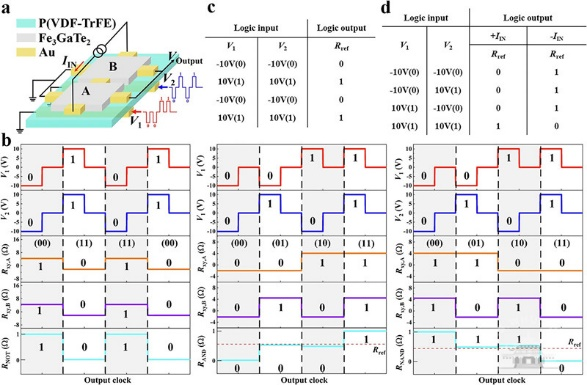
Voltage-controlled in-memory logic operations in multiferroic heterostructures.
A team led by Professor He Jun from the School of Physics and Technology at Wuhan University has made significant strides in magnetoelectric control of two-dimensional (2D) multiferroic heterostructures.
The team’s works, “Non-volatile electric-field control of room-temperature ferromagnetism in Fe₃GaTe₂ heterostructures” and “Ferroelectricity-driven strain-mediated magnetoelectric coupling in two-dimensional multiferroic heterostructure", have been published in Nature Communications.
The team has constructed high-quality van der Waals heterostructures of 2D ferromagnetic materials and ferroelectric polymers, achieving robust magnetoelectric coupling at room temperature. The Curie temperature of ferromagnetism can be adjusted between 247 K and 366 K.
This adjustment effect exhibits significant layer dependency: in 2D Fe₃GaTe₂ with three or fewer layers, positive voltage polarization increases the Curie temperature, while thicker samples show the opposite trend.
The team demonstrated multistate magnetization non-volatile memory and analog switching functions. The device can achieve up to 16 distinguishable resistance states under zero magnetic field by applying different polarization voltages, with excellent fatigue resistance.
The team also proposed a novel strain-mediated magnetoelectric coupling strategy, achieving non-volatile electric control of magnetic anisotropy reconstruction at room temperature.
These devices support both in-plane and out-of-plane magnetization orientations, offering dynamic programmability and overcoming the fixed function limitations of traditional single-gate devices. This provides a solid hardware foundation for developing adaptive and reconfigurable computing architectures.
The two research achievements provide a new theoretical framework and technical pathway for magnetoelectric coupling control in 2D multiferroic heterostructures and lay an important foundation for the future development of high-performance, low-power information devices.
 中文
中文