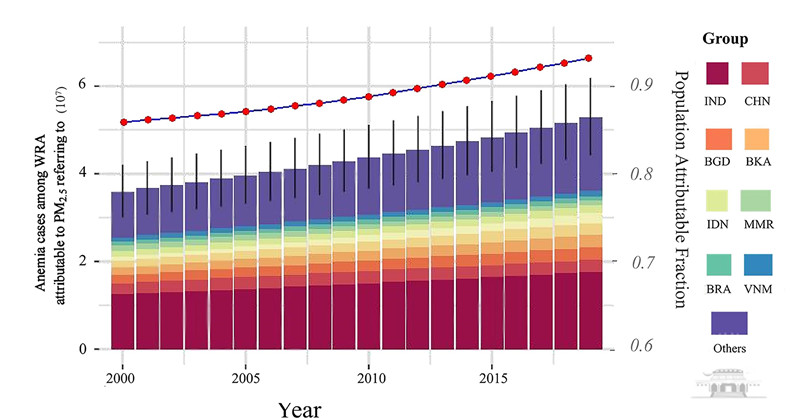
The burden of anemia attributable to wildfire-sourced PM2.5 from 2000 to 2019.
BMJ Global Health recently published groundbreaking research by Professor Xiang Hao's team from the Dong Fureng Institute of Economic and Social Development at Wuhan University.
The paper, Estimating Burden of Anemia in Women of Reproductive Age Attributable to Wildfire-sourced Fine Particulate Matters: A Multi-center Cross-sectional Study in Low-and-Middle Income Countries, focuses on anemia in women of reproductive age as a health outcome.
The research included 1.55 million women from 45 low- and middle-income countries (LMICs) between 2004 and 2021. By integrating ground-based monitoring and satellite remote-sensing data, the study estimated wildfire-derived PM2.5 concentrations in participants' regions and analyzed their association with hemoglobin levels and anemia prevalence.
The findings indicate that for every 1 μg/m³ increase in wildfire-sourced PM2.5 concentration, the average hemoglobin level in women of reproductive age decreases by approximately 0.126 g/L, and the risk of anemia increases by about 1.3 percent.
The research highlights a significant correlation between long-term exposure to wildfire-sourced PM2.5 and increased risk of anemia and decreased hemoglobin levels among women of reproductive age.
This underscores the potential health risks posed by wildfires and the urgent need to develop and implement effective policy measures to reduce wildfire occurrences and mitigate their health impacts.
The study provides critical insights into the global health implications of environmental change and the importance of addressing air pollution in public health strategies, particularly for vulnerable populations in LMICs.
 中文
中文