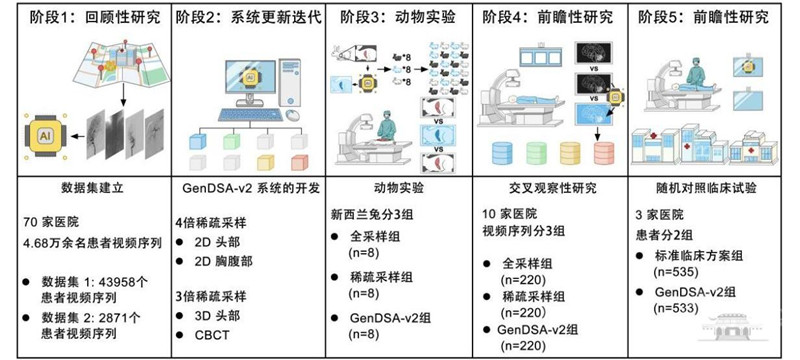
The flowchart for a prospective multicenter clinical registration trial.
Professor Du Bo and Associate Professor Zhao Huangxuan from the School of Computer Science at Wuhan University have made significant advances in medical artificial intelligence.
Their latest study, Generative AI-based Low-Dose Digital Subtraction Angiography for Intraoperative Radiation Dose Reduction: a Randomized Controlled Trial, published in Nature Medicine, introduces the world's first generative AI-based low-dose imaging system for digital subtraction angiography (DSA) equipment, named GenDSA-V2.
The innovative system has been validated through large-scale prospective clinical trials, demonstrating its ability to reduce intraoperative radiation doses to approximately one-third of the levels required by current clinical protocols for conditions such as cerebral aneurysms, arterial stenosis, liver cancer, lung cancer, and hemoptysis.
The research included a retrospective analysis of data from 46,829 patients across 70 centers, leading to the iterative development of the GenDSA-V2 system. The team further validated the system's effectiveness and safety through animal experiments, cross-sectional observational studies, and a multicenter randomized controlled trial involving 1,068 patients.
Compared with the standard clinical protocol group, patients in the GenDSA-V2 group experienced a significant reduction in radiation dose: air kerma (AK) decreased from 457.4 mGy to 151.3 mGy, and dose area product (DAP) dropped from 12,531.6 μGy·m² to 4,009.7 μGy·m², with reductions of approximately two-thirds.
The study also confirmed that there were no significant differences between the two groups in terms of surgery duration, complication rates, or image diagnostic quality, indicating that the system effectively reduces radiation dose without compromising surgical safety or diagnostic efficacy.
 中文
中文