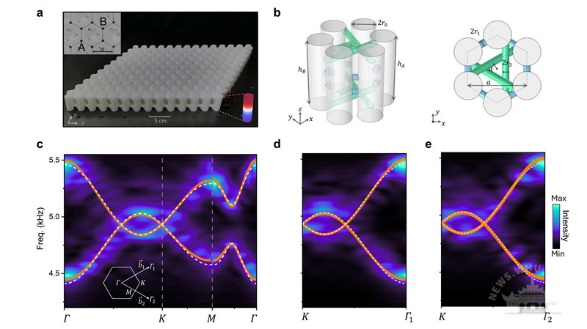
Experimental observation of acoustic satellite Dirac cones in phononic crystal samples.
A team led by Academician Liu Zhengyou from the School of Physics and Technology at Wuhan University has unveiled groundbreaking findings on satellite Dirac cones in phononic crystals. The study, Satellite Dirac cones in phononic crystals, was published in Nature Communications.
In layered graphene, quadratic Dirac cones represent a novel electronic band structure. These cones are unstable, evolving into a central linear Dirac cone surrounded by three additional linear Dirac cones, known as satellite Dirac cones, under slight second-neighbor interlayer coupling.
The researchers observed satellite Dirac cones in the acoustic frequency band by introducing weak nearest-neighbor coupling and strong third-neighbor coupling within a single-layer honeycomb lattice acoustic resonator.
The presence of these cones enriches the band topology in momentum space, enabling phononic crystals to support multiple acoustic edge states on specific boundaries. By modulating the height of sublattice acoustic cavities, the satellite Dirac cones were further split into satellite energy valleys, with valleys at the Brillouin zone corner surrounded by satellite valleys with opposite Berry curvature.
The multi-valley acoustic bandgap supports multiple acoustic interface transmission modes with varying valley polarizations, enabling simultaneous lateral splitting with valley polarization preservation and forward transmission with valley polarization inversion in a typical four-port acoustic beam splitter.
This research inspires the meticulous design and control of long-distance coupling effects in metamaterials, with potential applications in miniaturized on-chip solutions for high-throughput, interference-resistant signal transmission and identification.
Liu's team has also achieved significant results in other areas of topological phononic crystals, including the discovery of coexisting 2D surface and 1D edge topological BICs in 3D phononic crystals, the realization of 3D valley Hall phases, and the development of acoustic valley devices that integrate filters, valves, and splitters.
 中文
中文