A research by Professor Wang Cheng and his team from the College of Chemistry and Molecular Sciences at Wuhan University has been published in the Journal of the American Chemical Society.
The study, Tailored Metalloporphyrin-based Three-Dimensional Covalent Organic Frameworks for Enhanced Photocatalytic CO₂ Reduction, explores how the pore environment of three-dimensional covalent organic frameworks (COFs) affects the performance of photocatalytic CO₂ reduction.
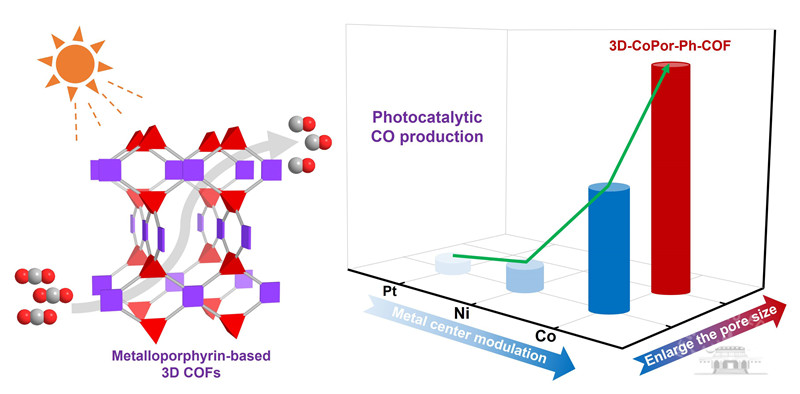
The team constructed a series of isostructural metalloporphyrin-based 3D COFs (3D-MPor-COF, M = Co, Ni, Pt) and demonstrated that different metal centers in the porphyrin affect photocatalytic performance.
3D-CoPor-COF exhibited the best performance, achieving a CO generation rate of 11.3 mmolg⁻¹ h⁻¹ with a selectivity of 91.9 percent. By extending the building units, the team further developed a larger-pore 3D-CoPor-Ph-COF, which increased the CO generation rate to 20.7 mmol g⁻¹ h⁻¹ with a selectivity of 95.4 percent.
Mechanistic studies revealed that larger pore sizes enhance mass transfer and diffusion efficiency, enabling solvents and CO₂ to reach the catalytic centers more smoothly. This accelerates the catalytic reduction process and improves photocatalytic efficiency.
This research confirms the importance of pore environment regulation in 3D COF photocatalysis and provides valuable insights into the structure-activity relationships of 3D COFs, laying a theoretical foundation for expanding their applications.
 中文
中文