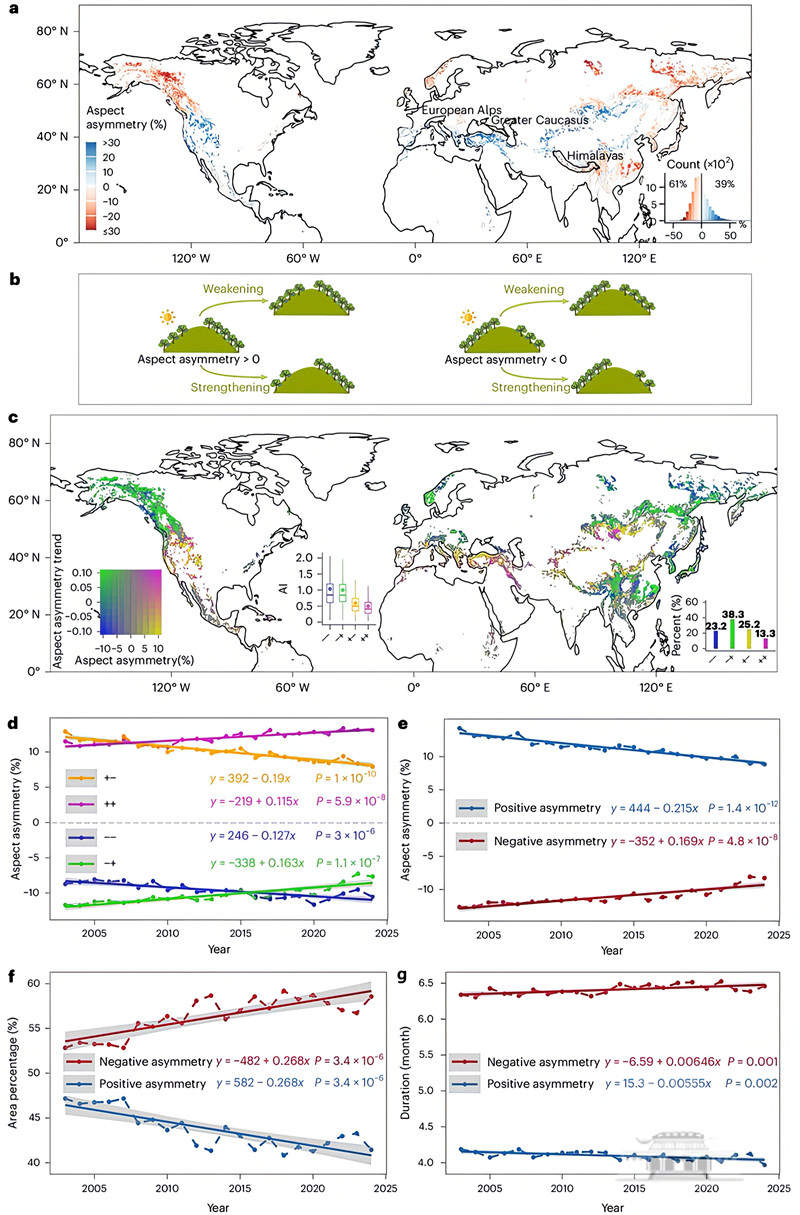
Changes in mountain vegetation aspect asymmetry from 2003 to 2024.
Professor Tian Feng's team from the School of Remote Sensing and Information Engineering at Wuhan University has published their paper, Weakening mountain vegetation aspect asymmetry due to altered energy conditions, in Nature Climate Change.
The study uncovers a crucial yet underexplored characteristic of slope aspect in mountain ecosystems, with important implications for ecosystem stability under climate change.
The study examines long-term changes in mountain vegetation aspect asymmetry from 2003 to 2024 and quantifies differences in vegetation density between poleward-facing (shady) and equatorward-facing (sunny) slopes in the Northern Hemisphere, mapping their spatial patterns.
In mid-latitude arid regions, shady slopes have better moisture conditions and denser vegetation, while in high-latitude humid regions, sunny slopes receive more solar radiation and have higher temperatures, resulting in denser vegetation.
Between 2003 and 2024, the vegetation density asymmetry across slope aspects exhibited a weakening trend. In regions with denser vegetation on shady slopes, the intensity, area, and duration of this density decreased. Conversely, in areas with denser vegetation on sunny slopes, the intensity diminished, but the area and duration increased.
Further attribution analysis revealed that changes in solar radiation and temperature are the primary drivers of these shifts in vegetation aspect asymmetry.
 中文
中文