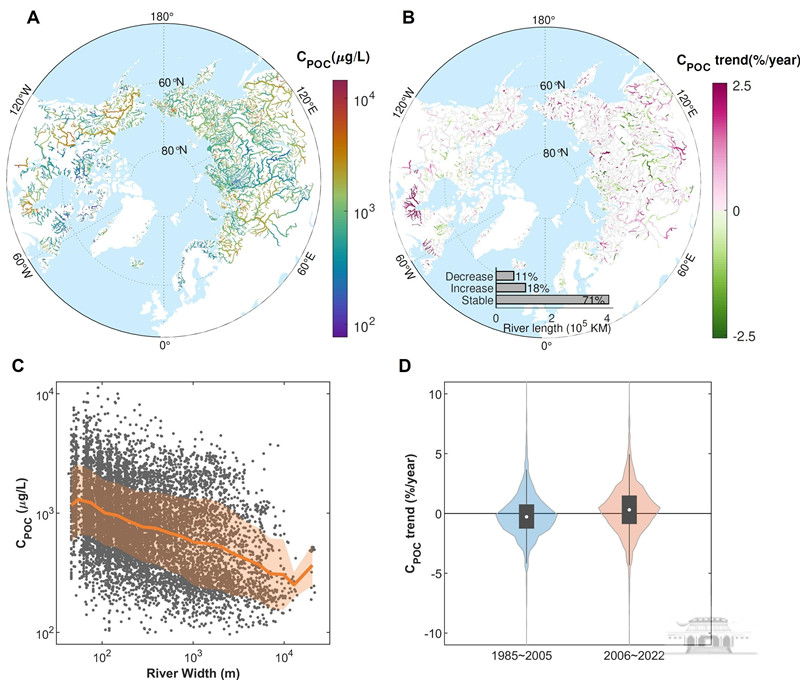
Distribution and trends of particulate organic carbon concentrations in pan-Arctic rivers from 1985 to 2022.
Professors Feng Lian and Tian Liqiao from Wuhan University's State Key Laboratory of Information Engineering in Surveying, Mapping, and Remote Sensing have made significant contributions to understanding particulate organic carbon (POC) in pan-Arctic rivers.
Their latest paper, Mapping Pan-Arctic Riverine Particulate Organic Carbon from Space (1985 to 2022), published in Science Advances, highlights groundbreaking findings on POC concentrations and fluxes.
The team combined satellite observations with concurrent ground measurements to develop a robust model for remote sensing retrieval of POC concentrations, leading to the creation of the first comprehensive remote sensing dataset of riverine POC across the pan-Arctic region.
The study reveals a net increasing trend in POC over the past 40 years. Eighteen percent of river segments showed a significant upward trend, while 11 percent exhibited a downward trend.
The study also analyzed the driving factors behind changes in riverine POC, finding a significant positive correlation between POC concentration changes and temperature in 97 watersheds, and with precipitation in 65 watersheds.
These findings are linked to surface processes such as "carbon release due to permafrost destabilization from rising temperatures" and "enhanced soil erosion due to increased moisture".
This achievement marks another milestone for the team, following their 2025 cover article Changes in global fluvial sediment concentrations and fluxes between 1985 and 2020 in Nature Sustainability.
The team will continue to focus on remote sensing data processing, algorithm development, equipment manufacturing, and monitoring and early warning applications for watershed-global scale water environments.
 中文
中文