Multifunctional hafnium oxide-modified perovskite solar cells and their exceptional stability.
A study led by Professor Wang Zhiping and his team from the School of Physics and Technology at Wuhan University has been published in Science, addressing a longstanding challenge in the development of efficient and stable perovskite solar cells.
The paper, Hafnium oxide interface stabilization for efficient, photothermally stable perovskite solar cells, introduces an "atomic-scale interface bonding" technique, using atomic layer deposition to integrate a tunable hafnium oxide (HfOx) interlayer at critical interfaces within the solar cell.
This method stabilizes both the hole and electron transport interfaces at an atomic scale, addressing the longstanding challenge of simultaneously improving the efficiency and stability of perovskite solar cells.
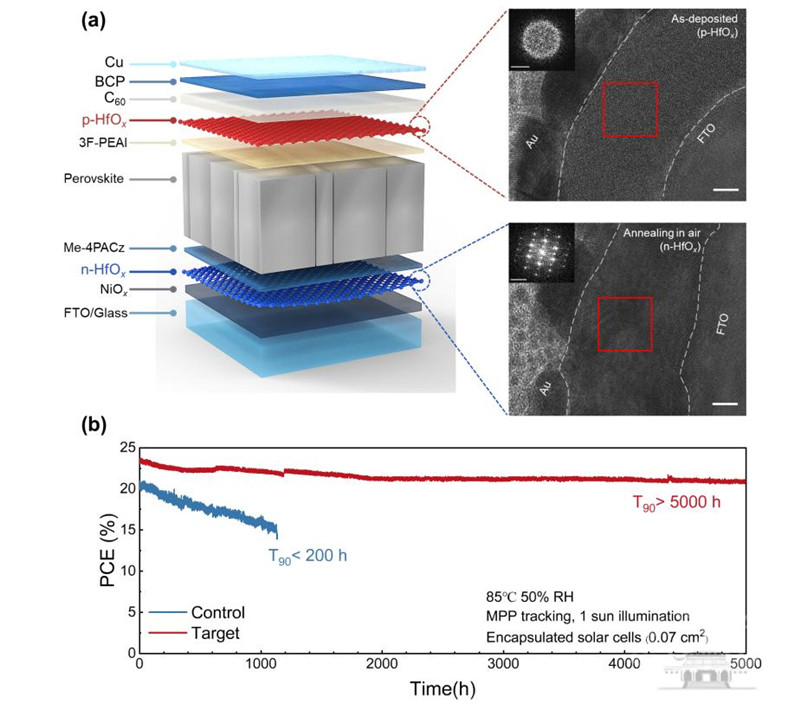
The research highlights the development of an atomic-scale interface bonding technique, where an annealed n-type HfOx interlayer is prepared at the hole transport layer interface.
This layer, rich in hydroxyl groups and exhibiting Lewis acidity, forms a robust tridentate coordination structure with self-assembled molecules, significantly enhancing the thermal stability and mechanical adhesion of the interface.
On the electron transport layer side, the p-type HfOx interlayer anchors passivation molecules through strong Hf···F bonding, preventing desorption at high temperatures and blocking iodine ion migration to the metal electrode, thus delaying device performance degradation from the source.
Solar cells utilizing this technology achieved an impressive power conversion efficiency of 27.1 percent, with a third-party certified efficiency of 26.6 percent. These cells maintained over 90 percent of their initial efficiency after operating for more than 5,000 hours under continuous illumination at 85 C, with a high-temperature operational lifespan (T90) 25 times that of control devices.
 中文
中文