Researchers from Wuhan University's Taikang Medical School and the College of Life Sciences have uncovered a novel mechanism that regulates transposons in germ cells.
The study, DAXX governs the silencing of LINE1 during spermatogenesis in mice, led by Professor Luo Mengcheng and Professor Li Guohong, has been published online in the journal Nucleic Acids Research and reveals, for the first time, how DAXX plays a crucial role in maintaining the silencing of LINE1 retrotransposons during spermatogenesis.
Retrotransposons are genetic elements that act as catalysts of evolution, promoting genomic diversity. However, they also pose a threat to the host genome's integrity. When epigenetic control is compromised, especially in germ cells, retrotransposons may become activated, leading to widespread genomic instability.
In mammals, the activation of retrotransposons is often associated with infertility.
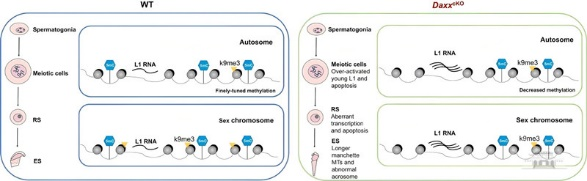
The study highlights that mice with germ cell-specific deletion of the Daxx gene exhibit abnormal activation of the young LINE1 retrotransposons in spermatocytes. This activation results in defective spermatogenesis and accelerated decline in fertility with age.
Detailed mechanistic investigations reveal that DAXX maintains LINE1 silencing by regulating H3K9me3 enrichment and DNA methylation in spermatocytes.
 中文
中文