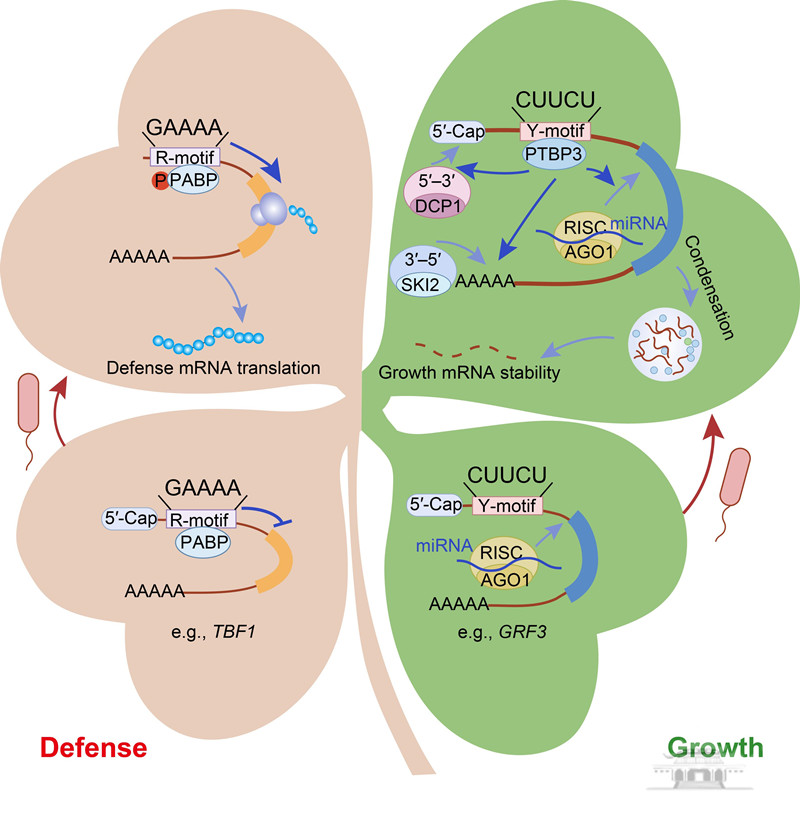
PTBP3/Y-motif (CU-rich) and PABP/R-motif (AG-rich) control growth and defense mRNAs.
A study by Professor Xu Guoyong's team from the Institute for Advanced Studies at Wuhan University has unveiled a novel mechanism by which RBP/RNA regulons regulate plant immunity.
The research, Immune activation reprograms growth mRNA stability to shape plant growth–defense trade-offs, has been published online in Cell Host & Microbe.
During systemic infections, plants often experience tissue damage, stunted growth, reduced yield, and even death. These growth costs can result from both direct pathogenic damage and "immunity-derived damage" triggered by immune responses. Balancing effective disease resistance while maintaining growth is a critical biological challenge for plants adapting to environmental stress.
The trade-off between growth and defense relies on the precise regulation of growth- and resistance-related genes in terms of expression intensity, timing, and spatial distribution.
While classic regulation at the DNA level is well-documented, emerging research highlights the crucial role of post-transcriptional mRNA stability, translation, and degradation — processes mediated by RNA-binding proteins (RBPs).
Xu and colleagues constructed an in vivo protein interaction network of RBPs and identified a key RNA-binding protein, POLYPYRIMIDINE TRACT-BINDING PROTEIN 3 (PTBP3), that regulates plant immune output. They found that PTBP3 recognizes growth mRNAs containing a Y-motif (rich in CU bases), thereby reprogramming growth-defense trade-offs at the post-transcriptional level.
The study proposes a growth mRNA regulon model centered on PTBP3/Y-motif: Upon immune activation, PTBP3 identifies the Y-motif rich in CU bases within the 5′-leader of growth genes.
It then assembles miRNA-mediated and 3′–5′ and 5′–3′ exonuclease-mediated RNA degradation pathways via phase separation, degrading growth-related mRNAs, including key targets such as GRF family members, thus blocking their translation. In ptbp3 mutants or GRF3 overexpression lines, elevated GRF levels enhance disease resistance and maintain growth resilience under immune activation.
This study reveals a functional division of RBP/RNA regulons in immune responses: the PTBP3/Y-motif (CU-rich) pathway promotes the degradation of growth mRNAs, while the PABP/R-motif (AG-rich) pathway facilitates the translation of defense mRNAs.
 中文
中文