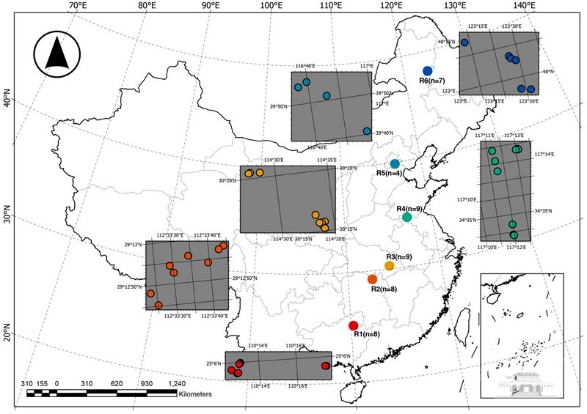
The design diagram of the latitude transect survey plot distribution and sterilization experiment.
Researchers from Wuhan University's College of Life Sciences have published a new study in New Phytologist, unveiling the pivotal role of epiphytic bacteria in enhancing the productivity of submerged plant communities.
The study, Climate‐driven epiphytic bacterial community along a latitudinal gradient and its implications for submerged macrophyte production, sheds light on the microbial dynamics that govern the growth of submerged macrophytes, such as Myriophyllum spicatum L., also known as Eurasian watermilfoil.
Epiphytic bacterial communities are known to influence the biogeochemical cycling of carbon and nitrogen, as well as host plant growth. While their biogeography has been studied in terrestrial ecosystems, little was known about their latitudinal diversity patterns and impact on submerged plants in freshwater ecosystems.
The team conducted an extensive survey across a 2800-kilometer latitudinal transect of China, examining the diversity of bacterial communities associated with the leaves and roots of Eurasian watermilfoil.
It also conducted surface-sterilization experiments on sediments from the sampling regions to validate the causal effects of epiphytic bacteria on plant biomass.
The findings reveal a pronounced latitudinal gradient in the diversity, nitrogen-cycling functional genes, and network structures of epiphytic bacterial communities. Climatic factors, such as average annual rainfall and temperature, influenced the phyllosphere bacterial communities.
The study establishes, for the first time, a causal relationship between epiphytic bacterial communities and primary production in freshwater ecosystems, highlighting that sediment nutrient levels may modulate the beneficial effects of these bacteria.
Understanding the intricate links between microbial community variation and their hosts’ ecology and evolution is crucial in the face of escalating global change and is vital for enhancing the functionality and ecological services of freshwater ecosystems.
 中文
中文