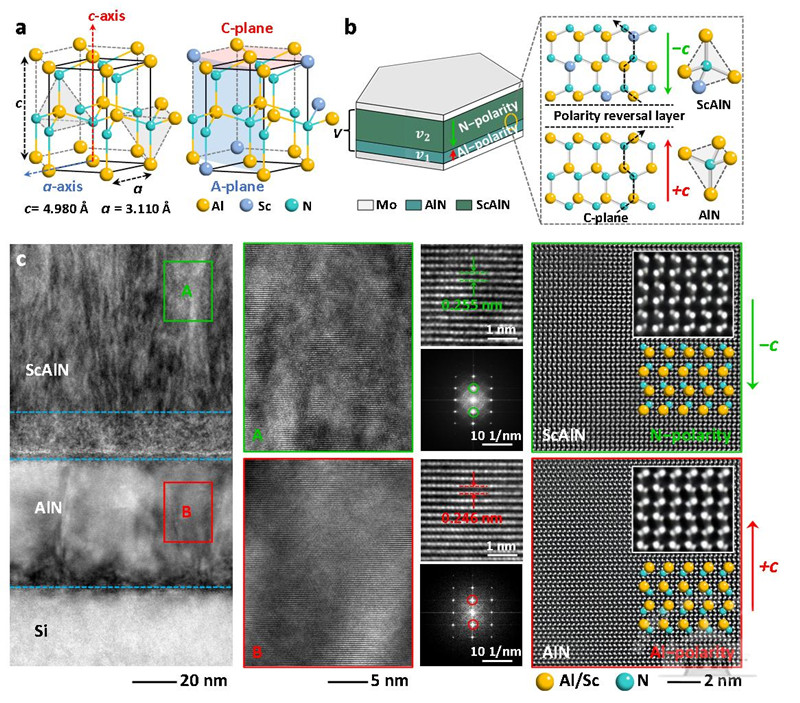
The diagram of the polarity inversion phenomenon and the dual optimization strategy for devices.
A team led by Professor Sun Chengliang and Associate Researcher Cai Yao at the School of Integrated Circuits, Wuhan University, has achieved a significant breakthrough in the development of high-performance Sub-7 GHz radio frequency acoustic filters.
Their innovative work, Enhancing film bulk acoustic resonators performance by optimizing AlN seed layer crystallinity and polarity alignment, has been published in Nature Communications.
The team introduced a pioneering "dual optimization strategy" to tackle the challenges of crystallinity degradation and polarity inversion in scandium-doped aluminum nitride (ScAlN) thin films.
By utilizing metal-organic chemical vapor deposition (MOCVD), they grew high-quality single-crystal aluminum nitride (AlN) seed layers, which guided the ScAlN films to achieve highly c-axis-oriented growth, thereby reducing acoustic losses and achieving a maximum resonator quality factor of 736.
The team also eliminated the polarity inversion interface, achieving precise polarity alignment and coupling restoration. Experimental results demonstrated that this strategy increased the effective electromechanical coupling coefficient of Film Bulk Acoustic Resonators (FBAR) devices from 6 percent to 13.2 percent.
The grid-type filter developed with this strategy achieved a center frequency of 6.4 GHz, a 3 dB bandwidth of 740 MHz, and an out-of-band rejection greater than 40 dB. These results underscore its substantial potential in Sub-7 GHz communication systems.
This breakthrough signifies a promising future for advanced RF filters, enhancing the performance and efficiency of next-generation communication technologies.
 中文
中文