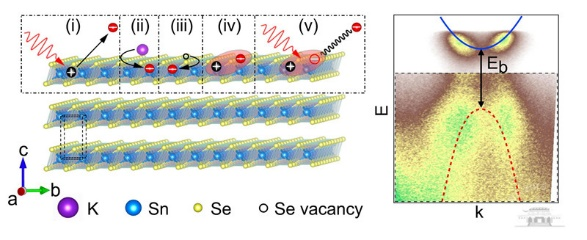
Generation and detection of quasisteady dark excitons in electron-doped SnSe₂.
Professor Xu Nan of Wuhan University, together with Researcher Meng Sheng's group from the Chinese Academy of Sciences' Institute of Physics, has made significant progress in the study of quasisteady dark excitons in semiconductors.
Their research, Observation of Quasisteady Dark Excitons and Gapped State in a Doped Semiconductor, has been published online in Physical Review Letters, addressing critical challenges in detecting and modulating dark excitons in semiconductors and offering fresh experimental insights into exciton physics and correlated quantum systems.
The team used an innovative approach that combined conventional Angle-Resolved Photoemission Spectroscopy (ARPES) to generate, characterize, and modulate quasisteady dark excitons in an electron-doped SnSe₂ semiconductor system.
Their experiments revealed that, under quasisteady-state conditions, photo-generated holes and doped electrons can form long-lived dark excitons with a binding energy of approximately 0.5 electron volts (eV). These excitons create distinctive spectral replicas of the valence band in the energy gap region, providing direct experimental evidence of their presence.
The study also found that the formation of dark excitons is linked to the opening of an anisotropic energy gap near the Fermi level in the material's conduction band. The researchers observed a strong correlation between dark excitons and the evolution of the gap, elucidating their intrinsic physical relationship.
This quasisteady-state research method broadens the experimental techniques available for dark exciton research, advancing foundational studies in exciton physics and unlocking potential applications in quantum information and high-performance optoelectronic devices.
 中文
中文