The latest research findings from Professor Guo Mian's team at the College of Chemistry and Molecular Sciences, Wuhan University, have been published in the Journal of the American Chemical Society.
The study, Li+ Promoted the Cyanation of Unactivated C–H Bonds Catalyzed by the Manganese Porphyrin Complex through Biomimetic Oxidation, marks a significant advancement in biomimetic catalytic oxidation by achieving cyanation of unactivated C-H bonds through a novel biomimetic oxidation strategy.
The direct activation of inert C-H bonds in alkanes to construct various functional groups, such as cyano groups, represents an ideal synthetic pathway for the production of functional organic molecules. However, the high bond dissociation energy of alkane C-H bonds presents a major challenge for their activation.
Oxidase systems, exemplified by cytochrome P450, can activate alkane C-H bonds under mild conditions, but their reaction products are hydroxylation products via the "oxygen rebound" pathway. This limitation has restricted the application of oxidases and their biomimetic oxidation systems in synthetic chemistry.
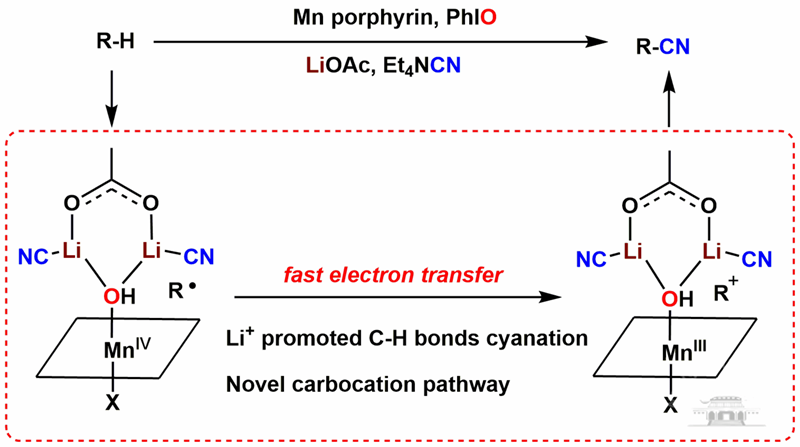
In this study, the researchers introduced Li+ as a Lewis acid into the manganese porphyrin biomimetic oxidation system, facilitating weak interactions with the high-valent manganese-oxo intermediates formed during the biomimetic oxidation process, suppressing the classical "oxygen rebound" pathway.
By introducing a cyanation reagent, the team achieved the challenging cyanation of inert carbon-hydrogen bonds in organic synthesis.
The reaction is compatible with a variety of alkane substrates and operates under mild conditions with good functional group tolerance. Characterization of intermediates, kinetic studies, and theoretical calculations suggest that the introduction of Li+ promotes the conversion of carbon radicals, formed after hydrogen abstraction from alkanes, into carbocation intermediates.
These intermediates then combine with the nucleophilic CN− to produce cyanated products.
This work provides a new synthetic pathway for cyanation reactions and lays a theoretical foundation for the development of biomimetic oxidation functionalization systems for alkanes.
 中文
中文