Professor Chu Zhaohui and his team from the College of Life Sciences at Wuhan University have published their latest research findings on copper ion-induced plant immune responses.
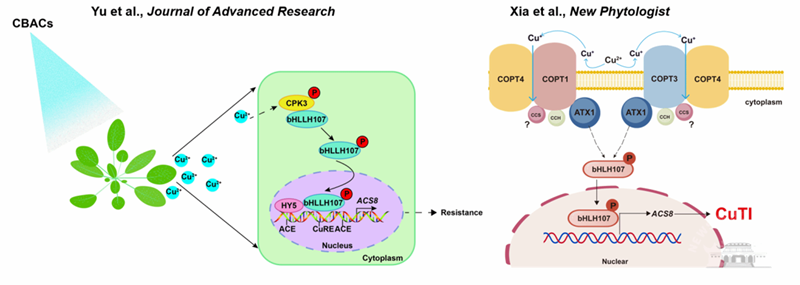
Their studies, The CPK3-mediated cytosolic–nuclear translocation of bHLH107 recruits HY5 to regulate the Cu2+-triggered upregulation of ACS8 and COPT4 interacts with COPT1 or COPT3 to manipulate the signaling response for copper-triggered immunity in Arabidopsis, were featured in the Journal of Advanced Research and New Phytologist.
Copper-based fungicides, a pioneering class of commercial pesticides, have been in use for over 140 years. Despite the emergence of copper-resistant pathogen strains, these formulations remain widely employed in agriculture due to their stability, broad-spectrum efficacy, affordability, and ecological safety.
The team has been at the forefront of research since 2015, unraveling the unique molecular mechanisms of copper-triggered immunity (CuTI) in plants. Their work continues to shed light on the "mystery" behind the sustained effectiveness and broad-spectrum nature of copper-based fungicides, contributing to the development of a "multi-layered immune" theory.
The two recent publications focus on the upstream signal recognition triggered by copper ions, dissecting the spatial signaling network within plant cells. This network involves the absorption of copper ions by the leaf cell membrane, activation of specific transcription factors in the cytoplasm, and induction of immune responses in the nucleus.
These findings provide a theoretical foundation for the formulation, dose reduction, genetic improvement, and utilization of copper-based products in sustainable and efficient agricultural practices.
 中文
中文