A research team led by Academician Gong Jianya from the State Key Laboratory of Information Engineering in Surveying, Mapping, and Remote Sensing at Wuhan University has published a study in Science Bulletin, revealing how urbanization accelerates and amplifies the effects of abrupt dry-wet transitions, a complex disaster scenario, posing significant threats to urban safety.
The study, Urbanization-induced compression effect accelerates and amplifies dry-wet abrupt alternations in Chinese cities, provides critical scientific insights to support urban flood control, water resource management, and resilience building.
The team utilized long-term meteorological data from 1961 to 2020, high-resolution WRF model simulations, and CMIP6 multi-scenario future projection data (2015-2100) to quantify the historical evolution of dry-wet transitions in 492 Chinese cities over the past 60 years.
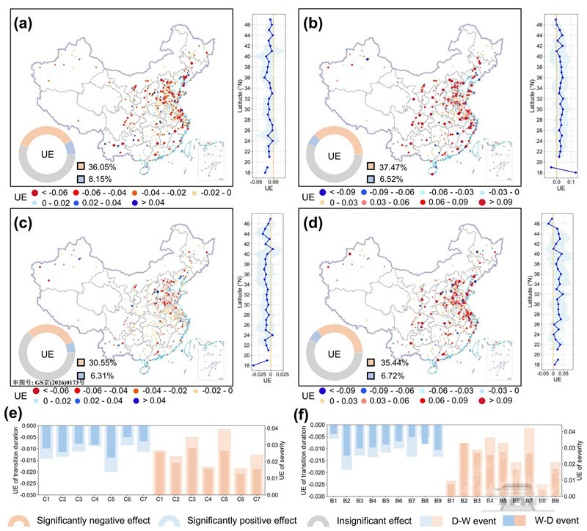
The research revealed that in cities larger than 50 square kilometers, approximately one-third exhibit a significant urbanization "compression effect," characterized by shortened intervals and intensified dry-wet transitions.
This effect is most pronounced in regions with high-intensity and rapid urban expansion, such as the eastern coastal areas and the North China Plain.
At the pixel scale, more than 50 percent of major urban areas have been affected by urbanization, with accelerated and intensified dry-wet transitions, and the response is stronger at the urban periphery than in the center.
The study further uncovered the underlying mechanisms: urban heat and dry island effects increase evapotranspiration demand, making drought phases drier; rapid expansion of impervious surfaces alters energy distribution, increases surface runoff, and accelerates the transition from wet to dry; and changes in the atmospheric boundary layer characteristics due to urban underlying surfaces promote convective triggers, making the transition from dry to wet more rapid and concentrated.
 中文
中文