A research team led by Professor Min Jie from the Institute for Advanced Studies at Wuhan University has made significant progress in understanding the high-speed processing capabilities of organic photovoltaic materials.
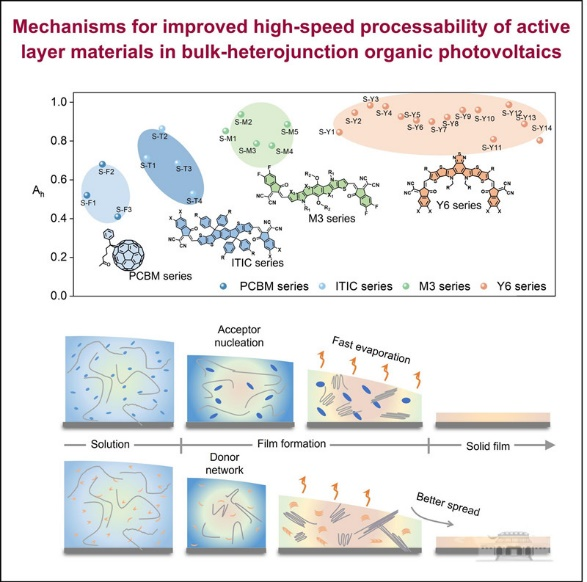
The team introduced a new metric, termed Ah, to quantify the high-speed processing potential of these materials. Their findings were published in Joule under the title Mechanisms for improved high-speed processability of active layer materials in bulk-heterojunction organic photovoltaics.
The study revealed that receptor databases with the same backbone exhibited concentrated Ah distributions, with the Y6 series demonstrating exceptional potential for high-speed coating.
The team discovered through steady-state fluid dynamics simulations and in-situ absorption and fluorescence spectroscopy that the solution-driven film formation process impacts the final morphology under high-speed coating conditions.
The team also conducted a detailed analysis of solute-solvent interactions and developed an HSP-based predictive model to calculate the donor crystallization priority (Pdc), providing a robust theoretical tool for evaluating material compatibility and high-speed processing potential directly from molecular structure.
The research further demonstrated that the saturation concentration (Sc) of receptor solutions and the spreading force of the wet film are positively correlated with the high-speed solution-processing performance of active-layer systems. High Ah systems require longer receptor aggregation times during the wet film stage to maintain optimal film formation, resulting in high device efficiency.
 中文
中文