A team led by Professor Cheng Fan from Renmin Hospital of Wuhan University and the university’s School of Pharmaceutical Sciences has unveiled a novel approach to tackling castration-resistant prostate cancer (CRPC).
Their study, Nanozyme-Mediated PROTACs Delivery for Targeted Protein Degradation and Ferroptosis Sensitization in Prostate Cancer, published in Angewandte Chemie International Edition, marks the first systematic integration of PROTAC-mediated protein degradation with nanozyme-induced ferroptosis.
This innovative strategy offers new hope for overcoming drug resistance in CRPC and lays the groundwork for the clinical translation of nanoPROTACs.
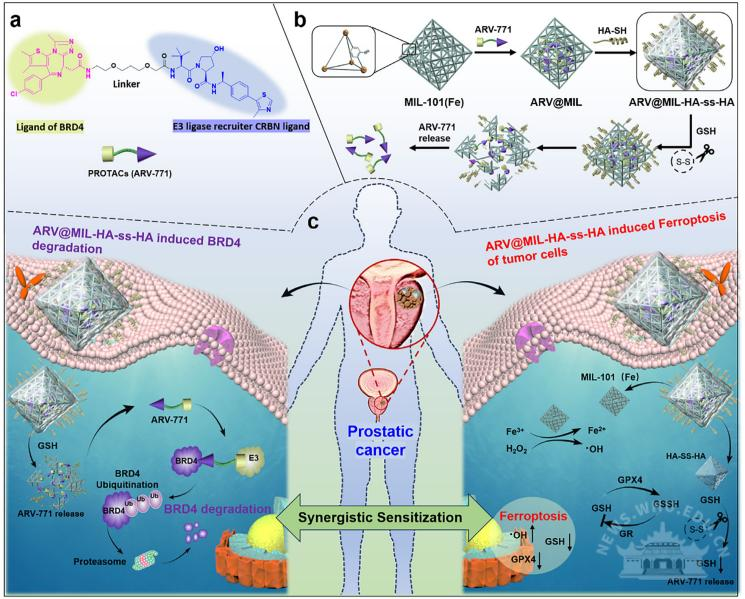
The team designed a multifunctional nanoPROTAC platform named ARV@MIL-HA-ss-HA, employing iron-based MOF material MIL-101 as a carrier for ARV-771, with a surface modified by a disulfide-crosslinked hyaluronic acid (HA-ss-HA) hydrogel.
The hydrogel facilitates active targeting through interaction with CD44 receptors, which are highly expressed on tumor cells, and enables responsive drug release triggered by the high glutathione (GSH) environment inside tumor cells.
The study employed in vitro cell experiments, proteomics analysis, in vivo tumor models, MRI, and fluorescence imaging to evaluate the platform's targeting ability, drug release characteristics, BRD4 degradation capacity, ferroptosis induction, anti-tumor efficacy, and biosafety.
Results confirmed that the ARV@MIL-HA-ss-HA platform combines the nanozyme activity of MIL-101 with the targeted protein degradation function of ARV-771, achieving efficient synergistic treatment of CRPC.
Both in vitro and in vivo experiments demonstrated significant improvements in tumor accumulation, BRD4 degradation efficiency, ferroptosis induction, and anti-tumor efficacy, alongside excellent biosafety.
 中文
中文