A team led by Professor Zhang Jun from the College of Chemistry and Molecular Sciences at Wuhan University has published a study in the journal Nature Communications.
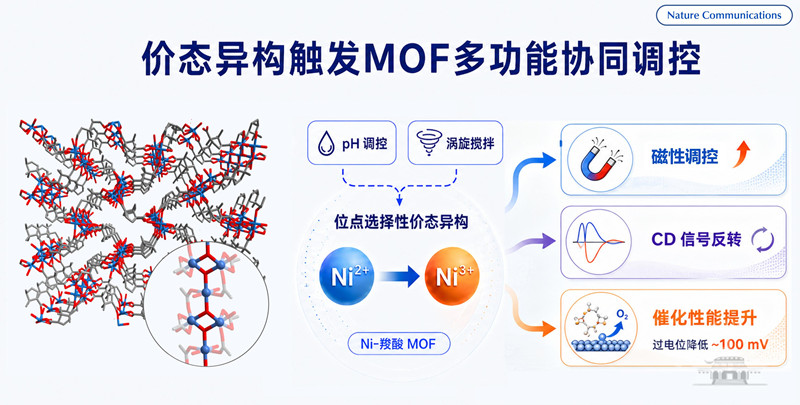
The paper, Site-Selective Valence Isomerism as a Unified Electronic Trigger for Magnetism, Chirality, and Catalysis in Ni-Carboxylate MOFs, reveals a novel mechanism for regulating the magnetic, chiral optical, and electrocatalytic properties of porous framework materials while maintaining the integrity of their lattice structure.
Metal-organic frameworks (MOFs) are known for their highly customizable structures, allowing precise control over pore size and chemical environment. These features make MOFs promising candidates for applications in chiral optoelectronic functions, energy catalysis, and quantum bit sensing.
A major challenge in this field has been achieving controllable adjustments of the valence state and electronic structure of metal centers within the framework without altering the crystal lattice structure.
To address this challenge, the team employed a synthesis strategy combining pH control of the reaction system with vortex-driven stirring, enabling the construction of a pair of structurally identical materials within a single Ni-carboxylate MOF. This allowed for the controlled preparation of both a Ni(II) parent phase and a mixed-valence Ni(II)/Ni(III) phase.
The study showed that approximately a quarter of the nickel sites underwent site-selective oxidation to form low-spin Ni3+ centers, which were distributed at specific metal node positions, creating valence isomerism structural units.
This local valence rearrangement had a synergistic impact on various properties of the material. It significantly enhanced the net magnetic moment at low temperatures by reconstructing intrachain magnetic exchange pathways.
It also reversed the direction of short-wavelength circular dichroism signals, indicating that changes in the local electronic structure can directly modulate chiral spectral responses.
The study highlights valence isomerism as an effective lattice-preserving electronic regulation strategy capable of triggering and optimizing multifunctional responses within a single framework system.
 中文
中文