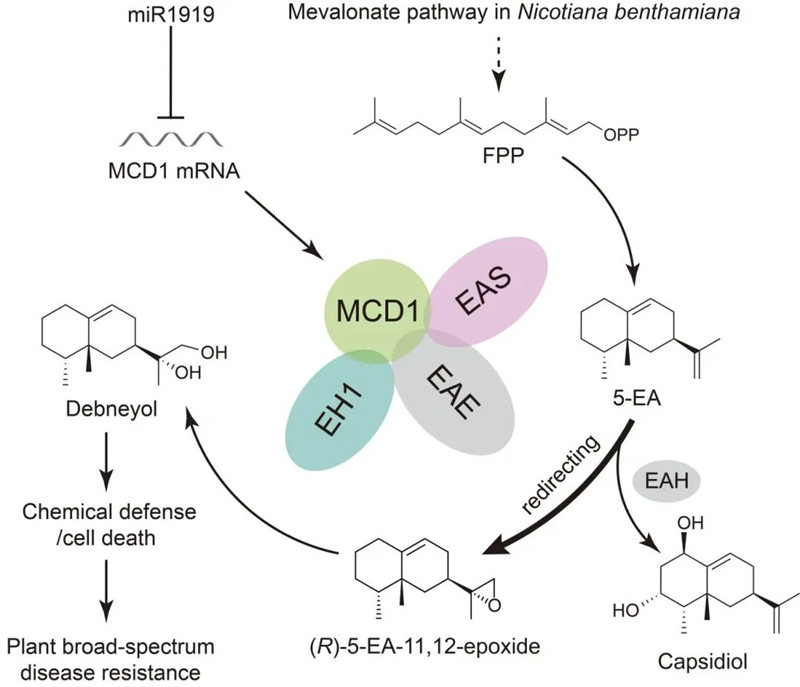
A collaborative research team from Tsinghua University's School of Life Sciences, Peking University's College of Chemistry and Molecular Engineering, and Wuhan University's School of Pharmaceutical Sciences published a study in the journal Cell on May 8.
The paper, Genetic basis of phytoalexin-mediated chemical defense in plants, elucidates the genetic foundation of debneyol-mediated chemical defense in plants, paving the way for engineering broad-spectrum disease-resistant crops and the large-scale production of the compound debneyol through synthetic biology.
Throughout their co-evolution with pathogenic microorganisms, plants have developed a multi-layered defense system, with chemical defenses serving as a crucial barrier against invasion.
Debneyol, a sesquiterpenoid phytoalexin unique to Solanaceae plants, such as tobacco and pepper, shares the precursor 5-epi-aristolochene (5-EA) with the classic phytoalexin capsidiol but exhibits stronger broad-spectrum antifungal activity.
Since its discovery in 1979, the biosynthesis and regulatory mechanisms of debneyol have remained elusive, posing a longstanding challenge in the field of plant defense.
The team decoded and reconstructed the biosynthetic pathway of debneyol, unveiling the core regulatory role of the miR1919-MCD1 module in this pathway. They also showed that MCD1 can direct metabolic flux toward debneyol synthesis by organizing a multi-enzyme complex, thereby significantly enhancing the plant's broad-spectrum resistance to fungi, viruses, and bacteria.
 中文
中文