Professor Du Bo and Associate Professor Zhao Huangxuan from Wuhan University's School of Computer Science have unveiled a new lightweight AI system for interpreting chest radiographs.
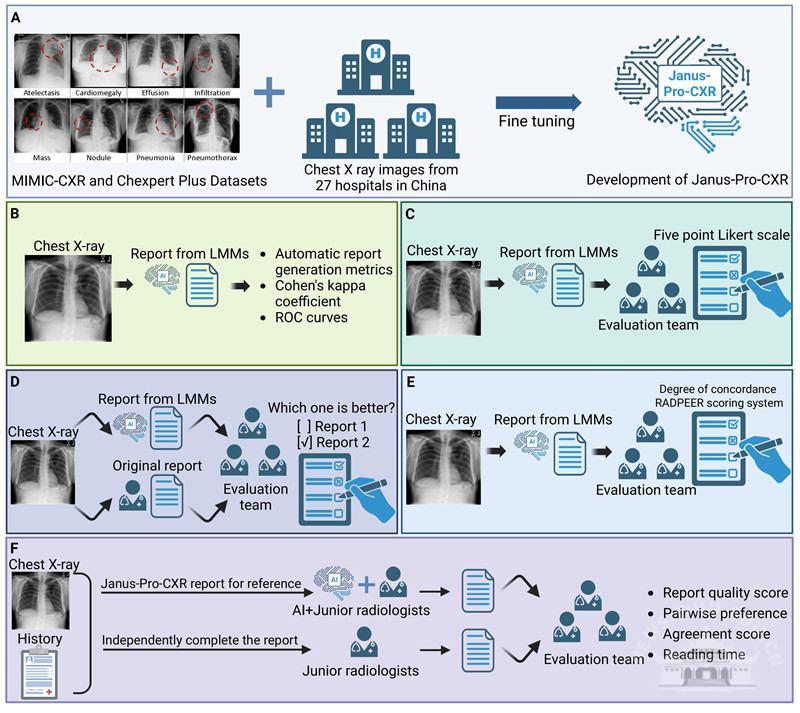
Their research, A DeepSeek-powered AI system for automated chest radiograph interpretation in clinical practice, has been published in Nature Communications. It introduces the Janus-Pro-CXR system based on the DeepSeek multimodal large model and was validated through a multicenter prospective study conducted in real clinical settings.
The team developed a collaborative large-small model architecture based on the open-source DeepSeek multimodal large model Janus-Pro, during which a unified model works in tandem to precisely identify critical lesions.
The team also proposed a two-level knowledge distillation framework, condensing the inference capabilities of the original large model into a lightweight system with only 1 billion parameters.
The Janus-Pro-CXR system lowers the deployment threshold of AI technology in medical institutions and can perform rapid image analysis and report generation in just 1-2 seconds using a portable computer equipped with a standard consumer-grade graphics card.
The system demonstrated outstanding performance in automated report generation, with reports indistinguishable from those written by human experts.
The team also conducted a core prospective clinical validation involving 296 patients across three hospitals, with results showing that the AI-assisted group achieved significantly higher report quality and consistency scores compared to the standard diagnostic group.
The average time required per report was reduced by approximately 27 seconds, an 18.3 percent decrease, maintaining a notable advantage even in complex cases. The structured prompts provided by the AI also increased the positive diagnosis rate for pneumonia by junior physicians from 36.1 percent to 52.4 percent.
 中文
中文