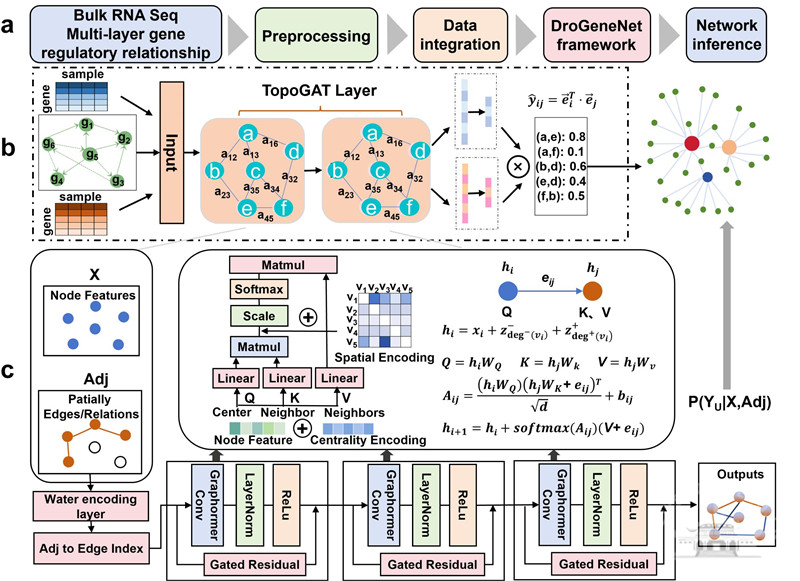
The DroGeneNet AI algorithm framework.
Professor Shi Liangsheng's team at Wuhan University’s School of Water Resources and Hydropower Engineering has utilized artificial intelligence to shed light on the conserved mechanisms and divergent paths of drought resistance in crops, unveiling a new hypothesis.
The study, Conserved and divergent gene regulatory networks for crop drought resistance, was published in Nature Communications. It proposed that crop drought stance is constrained by the evolutionary topology of gene regulatory networks.
The team integrated large-scale transcriptome sequencing data from major cereal crops such as rice, wheat, and sorghum to map drought response profiles, and developed a deep learning algorithm called DroGeneNet to construct a large-scale drought response regulatory network.
The network covers approximately 130,000 genes and 3.3 million interactions, providing an intelligent tool for analyzing plant water sensing, signal transduction, and physiological regulation.
A power-law relationship was also discovered between transcription factor activity and network average degree, indicating that similar transcription factor changes induce greater network restructuring in C3 crops, while C4 crops maintain more robust structures.
Researchers identified cross-species conserved drought regulatory modules, such as TCP-PP2C and ERF-2OGD, which are linked to abscisic acid signaling and redox homeostasis, serving as universal drought resistance chassis.
The study also highlights unique drought strategies among different crops, with C3 crops showing modules related to growth and morphological regulation for drought avoidance, and C4 crops displaying modules associated with photosynthesis, nitrogen metabolism, and stress signaling for drought tolerance.
This research links drought research with efficient agricultural water resource utilization, helping to cultivate crop varieties capable of maintaining yields under water scarcity, and providing a new foundation for agricultural water conservation and breeding drought-resistant varieties.
 中文
中文