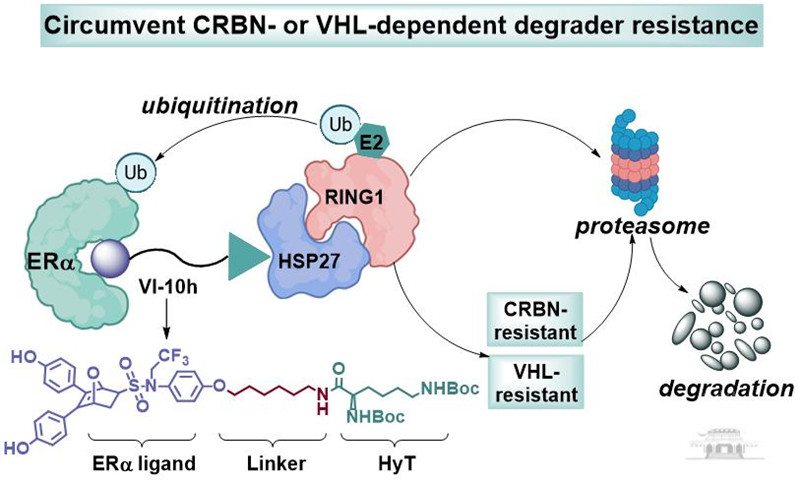
A recent study by Professor Zhou Haibing's team at Wuhan University's School of Pharmaceutical Sciences, in collaboration with Professor Liang Kaiwei's team at Taikang Medical School, has been published online in Angewandte Chemie International Edition.
The paper, Hydrophobic Tag Degraders Overcome Endocrine-Resistant Breast Cancer by Recruiting HSP27-Mediated E3 Ligase Complex for ERα Proteasomal Degradation, reveals a novel approach to tackling drug-resistant breast cancer.
Current Targeted Protein Degradation (TPD) drugs rely on classical E3 ubiquitin ligases, including CRBN and VHL, which can lead to secondary resistance with prolonged use, limiting their clinical efficacy. Thus, developing novel degradation technologies that depend on non-classical E3 ligases is a frontier in overcoming endocrine resistance.
This study focuses on the rational design and discovery of novel Hydrophobic Tag (HyT) ERα-targeted degraders. It elucidates, for the first time, a new mechanism of HSP27-mediated non-classical E3 ubiquitin degradation, addressing the resistance limitations of traditional degraders and providing a new drug design strategy and candidate molecules for the precise treatment of resistant breast cancer.
Researchers employed various alkyl chain linkers to couple hydrophobic amino acid tags with ERα-targeting ligands, constructing a series of HyT degraders and identifying the lead compound VI-10h.
This compound inhibits the proliferation of various breast cancer cell lines and degrades ERα protein. Xenograft tumor model validation showed that VI-10h's tumor-suppressing effect surpasses that of the clinical drug fulvestrant.
Biochemical experiments, including mass spectrometry and pull-down assays, revealed that VI-10h specifically recruits HSP27 protein as a bridging protein for non-classical E3 ligase, forming an ERα–HSP27–RING1 ternary functional complex.
This mediates ERα protein ubiquitination and proteasomal degradation, blocking the estrogen receptor oncogenic signaling network.
 中文
中文