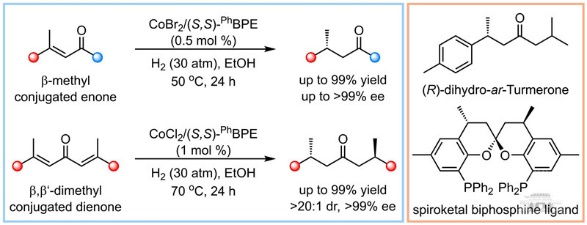
A team led by Wang Chunjiang and Dong Xiuqin from the College of Chemistry and Molecular Sciences at Wuhan University has achieved a new milestone in asymmetric hydrogenation.
Their latest research, Cobalt-Catalyzed Asymmetric Hydrogenation Enables Concise Synthesis of Chiral β-Methyl Ketones and β,β′-Dimethyl Ketones, published in the Journal of the American Chemical Society, explores the use of cobalt catalysts in the asymmetric hydrogenation for the concise synthesis of chiral β-methyl ketones and β,β'-dimethyl ketones.
Researchers have devised several asymmetric synthesis strategies to obtain chiral β-methyl ketones, including chiral auxiliary-induced asymmetric alkylation, catalytic asymmetric reduction of β-methyl conjugated enones, and catalytic asymmetric conjugate alkylation reactions.
The catalytic asymmetric reduction of C=C bonds in β-methyl conjugated enones is considered one of the most efficient pathways to achieve such chiral frameworks.
Transition metal-catalyzed asymmetric hydrogenation relies on noble metal catalysts such as iridium, rhodium, and palladium, which exhibit high catalytic efficiency. Despite significant advancements, existing methods often suffer from drawbacks like reliance on expensive noble metals, poor chemoselectivity, and environmental concerns.
There have been no reports of asymmetric hydrogenation of β-methyl conjugated enones catalyzed by the inexpensive metal cobalt.
The team employed Rh(I)/(S)-DTBM-SegPhos in 2024 to catalyze the mono-asymmetric hydrogenation of β'-methylene conjugated enones and the double asymmetric hydrogenation of β,β'-dimethylene ketones, achieving a series of chiral β'-methyl enones and β,β'-dimethyl ketones with excellent regioselectivity and enantioselectivity (Angew. Chem. Int. Ed. 2025, 64, e202414449).
They recently reported, for the first time, an efficient cobalt-catalyzed asymmetric hydrogenation reaction using available β-methyl conjugated enones as substrates, enabling the rapid synthesis of a series of chiral β-methyl ketones with outstanding chemoselectivity and enantioselectivity.
This catalytic system can also be extended to symmetric β,β'-dimethyl conjugated dienones, yielding a series of chiral β,β'-dimethyl ketones with high yields and excellent diastereoselectivity and enantioselectivity.
The team also achieved the concise synthesis of (R)-(+)-dihydro-aryl-curcumin and a novel spirocyclic chiral bisphosphine ligand, highlighting the potential synthetic applications of this approach.
 中文
中文