Researchers from Wuhan University’s School of Physics and Technology have made significant strides in exciton transport in two-dimensional (2D) semiconductors, with their study, Exciton steering via potential landscape engineered by excited electron-hole phase transition, published in Physical Review Letters.
Excitons in 2D semiconductors have garnered considerable attention due to their strong light-matter interactions. However, because excitons are electrically neutral, they are challenging to manipulate directly using electric fields.
Traditional methods, such as using strain gradients, often damage the material, while heterojunctions for interlayer exciton transport suffer from weak light-matter interactions. Thus, achieving efficient, reversible optical control of intralayer exciton transport has remained a longstanding challenge in the field.
Addressing this issue, the team utilized monolayer molybdenum disulfide (MoS2) to construct a spatial gradient of potential energy through a light-driven phase transition from high-excited-state excitons to an electron-hole liquid.
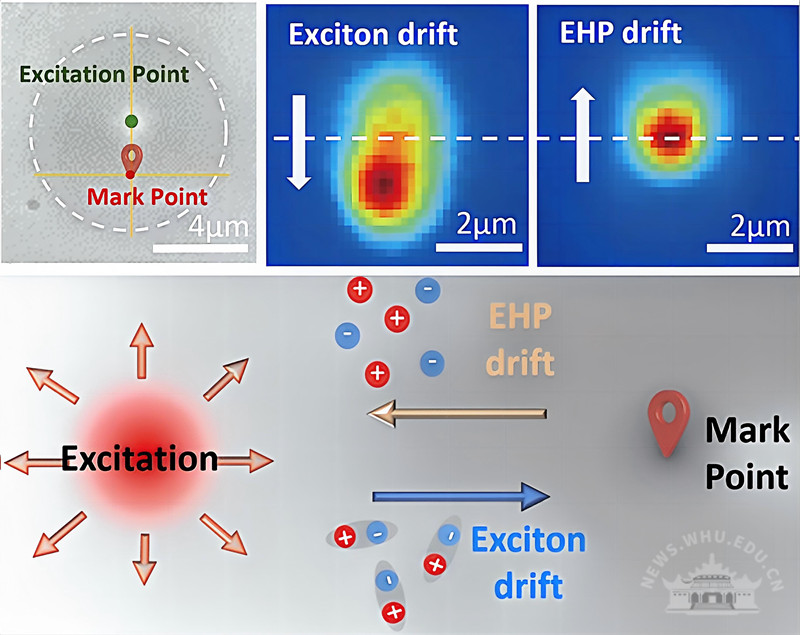
This innovation enables full optical control of directional exciton transport within the layer, revealing that in the liquid phase formed by the high-excited-state phase transition, Coulomb screening from charge distribution creates an exciton binding energy gradient, driving excitons to move towards regions with higher binding energy.
The constructed potential gradient exerts opposite driving forces on excitons and unbound electron-hole pairs (i.e., electron-hole plasma, EHP) — excitons, as quasiparticles, move towards areas of higher binding energy, while free carriers migrate along the electron band gradient.
This research demonstrates damage-free, switchable directional transport of excitons and carriers through simple manipulation of excitation light position, offering a novel approach for developing reconfigurable exciton interconnects and quantum optical devices.
 中文
中文