A collaborative team led by Professor Xu Ke from the College of Life Sciences at Wuhan University and Professor Liu Huan from the School of Integrated Circuits at Huazhong University of Science and Technology has made significant progress in virus detection technology.
Their study, Real-Time and Non-Invasive Detection of Respiratory Viral Infections Using an Intelligent Odor Monitoring System (IOMS), was recently published in Advanced Science.
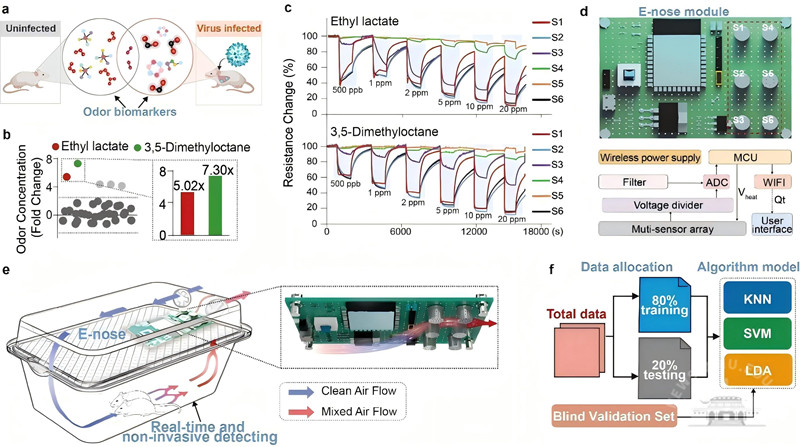
The team has developed an intelligent odor monitoring system (IOMS) that utilizes a highly sensitive gas sensor array and machine learning algorithms to detect abnormal signals in exhaled breath, similar to olfactory fingerprint recognition.
Researchers embedded a semiconductor sensor array in animal cages to monitor VOCs in situ at a frequency of once per second over seven days, which can detect early changes in odor fingerprints within 7-8 hours of viral exposure, enabling dynamic "sniffing" throughout the entire course of the disease, from the incubation period to recovery.
In a mouse influenza infection model, the IOMS identified infection-related characteristic gases using a six-channel sensor array and machine learning modeling. Each experiment produced 3,628,800 longitudinal monitoring data points per group.
After averaging and noise reduction with an 18-second ventilation cycle, the infection and control groups were separated into principal component spaces, with the odor fingerprints evolving with the disease course.
Three machine learning algorithms validated the results, achieving an internal test set accuracy of 99.88 percent and an independent blind test accuracy of 93.99 percent. The accuracy remained above 98 percent during the early infection period (1-3 days).
The first 72 hours of infection are a critical window for antiviral treatment and breaking the transmission chain, but the low viral load during this period often escapes detection by traditional antigen and nucleic acid tests. The system facilitates the transition from potential to reality for ultra-early, non-invasive screening.
 中文
中文