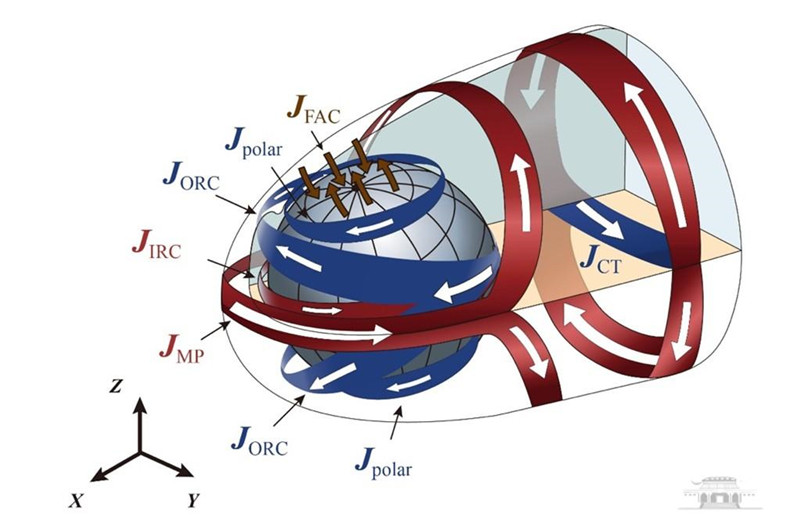
The diagram of Mercury's global magnetosphere current system.
A team led by professors Yuan Zhigang and Huang Shiyong from Wuhan University's School of Earth and Space Science and Technology has reconstructed Mercury's global magnetosphere current system for the first time.
Their study, Global current systems in the magnetosphere of Mercury, published in Nature Communications, reveals that Mercury's magnetosphere is a unique system shaped by strong solar winds, a weak intrinsic magnetic field, and a thin exosphere.
The research identifies magnetopause currents and cross-tail currents similar to those found in Earth's magnetosphere, uncovering both inner and outer equatorial ring currents, as well as an undiscovered polar ring current.
Key contributors to this research include James A. Slavin and Jim M. Raines from the University of Michigan, Fouad Sahraoui from the French National Center for Scientific Research, and Brian J. Anderson from Johns Hopkins University Applied Physics Laboratory.
Previous studies provided only partial insights into Mercury's magnetospheric current systems, often yielding contradictory results about the direction of ring currents.
Using long-term data from Messenger's orbital mission from 2011 to 2015, the team constructed an average three-dimensional magnetic field image of Mercury's magnetosphere, offering a comprehensive view of its global current system.
The study identifies magnetopause currents near Mercury's dayside magnetospheric boundary and cross-tail currents spanning the nightside plasma sheet, forming a closed current loop.
Within Mercury's inner magnetosphere, two oppositely directed equatorial ring currents were discovered: an outer equatorial ring current and an inner equatorial ring current. These are driven by uneven pressure distributions of charged particles, causing ions and electrons to drift in opposite directions, thereby forming ring currents that encircle the planet.
A significant finding is the persistent polar ring current in mercury's high-latitude northern region, flowing near the planet's north pole and distinct from the equatorial ring currents.
The study suggests that the polar ring current may be related to plasma pressure gradients in Mercury's cusp region, where solar wind particles entering along open magnetic field lines create localized pressure enhancements, driving proton drifts and generating the polar ring current.
 中文
中文