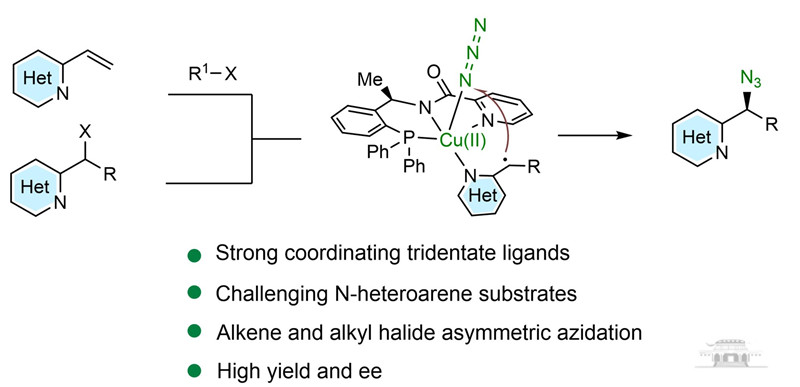
Professor Chen Caiyou's team from the College of Chemistry and Molecular Sciences at Wuhan University has published their latest research in Nature Catalysis, introducing a novel ligand design that enhances copper-catalyzed asymmetric radical azidation of N-heteroaromatic benzylic sites.
The study, Unlocking the Cu-catalyzed asymmetric radical azidation of N-heterobenzylic sites through rational ligand design, designed and synthesized a new class of strong-coordinating chiral tridentate ligands, which have been applied to the challenging asymmetric radical azidation of nitrogen-containing heterocyclic substrates.
This design inhibits catalyst poisoning caused by the competitive coordination of N-heteroaromatics and prevents the formation of low-selectivity bis-azido Cu(II) species, thus reshaping the coordination chemistry of the copper-azide system.
Utilizing TMSN3 (trimethylsilyl azide), an inexpensive, low-toxicity, and neutral azide source, the study achieves the copper-catalyzed enantio-convergent asymmetric radical azidation of 2-(1-haloalkyl)-containing nitrogen heterocycles with excellent yields and enantioselectivity.
The research also demonstrates the copper-catalyzed three-component asymmetric radical azidation of 2-vinyl-containing nitrogen heterocycles, which is compatible with a variety of strong-coordinating nitrogen heterocycles and complex molecules, scalable to gram-level synthesis, and applicable to the transformation of at least five bioactive molecules and pharmaceutical intermediates.
Mechanistic experiments conducted in this study reveal the radical azidation mechanism involving halogen atom abstraction, ligand exchange, and inner-sphere homolytic substitution.
The findings elucidate the principle by which the novel PNN ligand mitigates catalyst poisoning by nitrogen heterocycles, providing new directions for the metal-catalyzed asymmetric radical functionalization of strong-coordinating substrates.
 中文
中文