Professor Chen Suming's team from the Institute for Advanced Studies at Wuhan University has made strides in isomer-specific mass spectrometry analysis, with their research, Enzyme-centric chemoproteomics reveals isomer-specific S-acylation modification networks, published in Nature Communications.
Protein S-acylation is a crucial post-translational modification mediated by the zDHHC enzyme family, influencing protein subcellular localization, secretion, and stability. While there has been substantial research on fatty acid-modified proteins, the intricate relationship between the fine structure of fatty acids and their S-acylation specificity remains elusive.
Understanding the relationship between fatty acid structural isomers and protein S-acylation specificity could reveal the fine regulatory mechanisms of protein lipid modification networks, addressing a longstanding gap in the field.
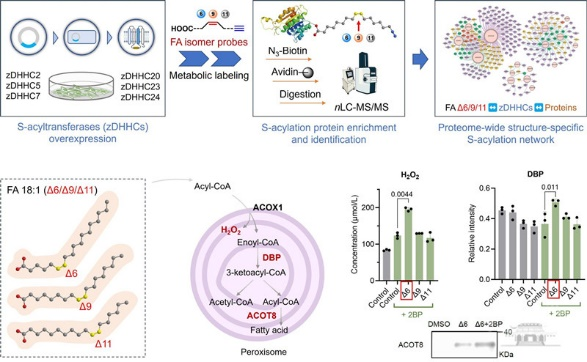
The team developed an enzyme-centric chemoproteomics approach, employing designed fatty acid double-bond position isomer probes, combined with zDHHC enzyme overexpression systems and high-resolution mass spectrometry-based quantitative analysis techniques.
They demonstrated significant selectivity in protein lipid modification concerning fatty acid C=C double-bond position isomers.
The study mapped the interaction networks between fatty acid isomers, zDHHC enzymes, and S-acylated proteins, elucidating the preference and spatial binding characteristics of different zDHHC enzymes during the formation of self-acylation intermediates.
The research also discovered that different fatty acid isomers create distinct S-acylation networks and lead to diverse biological functions. The fatty acid isomer modifies the key enzyme ACOT8 in the fatty acid β-oxidation pathway, promoting DBP expression and H₂O₂ production.
This work is the first to decipher the core structural basis determining the specificity of unsaturated fatty acid modifications, providing critical evidence for understanding the fine regulatory mechanisms of protein lipid modifications.
 中文
中文