A team led by Wang Dehua and Yin Huayi from the School of Resources and Environmental Sciences at Wuhan University has made significant advancements in the resource utilization of new energy solid waste, presenting novel solutions for the high-value recycling of solid waste from new energy sources.
One of the core challenges in the recycling of photovoltaic solid waste is the selective separation of metal grid lines from semiconductor substrates in decommissioned crystalline silicon photovoltaic modules.
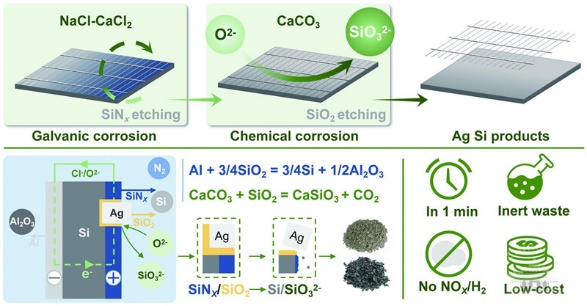
To address this, the team developed a synergistic approach based on a molten NaCl-CaCl2 system, utilizing both electrochemical and chemical etching to achieve direct separation of Ag and Si.
By introducing additives such as CaCO3/CaO into the NaCl-CaCl2 molten salt system, the team created a high-temperature ionic reaction environment. An aluminum back electrode serves as a sacrificial anode to drive in-situ electrochemical etching of the SiNx/SiO2 interface layers.
The active species generated in the molten salt, such as O2-, further promote chemical etching of these layers, enabling efficient separation of Ag grid lines in less than one minute and simultaneous recovery of Si.
Life cycle assessment (LCA) and cost analysis (LCC) further demonstrate the method's potential to significantly reduce carbon emissions and economic costs, paving the way for the green and high-value recycling of waste crystalline silicon photovoltaic modules with industrial potential.
This research is published in Science Bulletin.
Waste sodium sulfate (Na2SO4) is a common by-product in industries such as chemical and metallurgical processes, often found in flue gas desulfurization, lithium battery recycling, and basic chemical production systems. Improper handling of Na2SO4 can lead to severe environmental accumulation risks and resource wastage.
Thus, achieving high-value resource conversion of waste Na2SO4 and establishing a sustainable sodium-sulfur element cycle is a critical research direction in resource recycling and green chemistry.
The team has developed an ammonia-free (NH3-free) two-step thermochemical coupling approach to convert waste Na2SO4 into high-purity sodium carbonate (Na2CO3) and elemental sulfur (Sx).
The team uses carbothermal reduction to convert Na2SO4 into Na2S, followed by a carbonation reaction in a CO2 atmosphere to produce Na2CO3 while fixing the sulfur element as Sx.
This process enables the recycling of CO2 and clean transfer of sulfur, overcoming the key bottlenecks of traditional SSA processes, which are dependent on NH3, burdensome, and water-intensive.
Achieving a high yield (95.35 percent) and high purity of Na2CO3, the method reduces lifecycle environmental impact and carbon emission intensity, offering a novel green thermochemical conversion pathway for the large-scale clean utilization of waste Na2SO4.
This research is published in Nature Communications.
 中文
中文