A team led by Professor Yan Jianguo from State Key Laboratory of Information Engineering in Surveying, Mapping, and Remote Sensing at Wuhan University has made significant advances in the study of asteroid gravity fields and internal structures.
Their latest research, The shallow subsurface heterogeneities of asteroid Ryugu revealed by its gravity field, has been published in Nature Astronomy.
Utilizing data from the Hayabusa2 mission, including laser altimeter (LIDAR) and landmark tracking images, the team developed a fourth-degree global gravity field model for asteroid Ryugu.
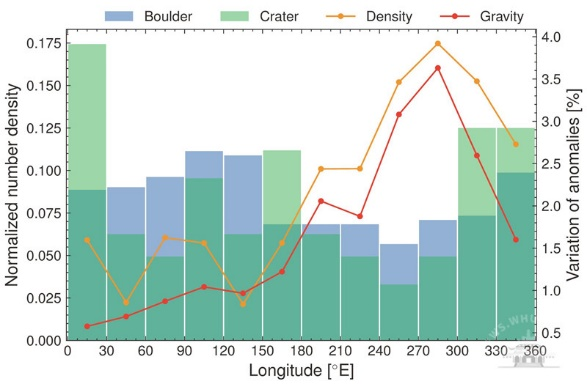
Their findings revealed a notable east-west dichotomy in surface gravity anomalies: the western hemisphere exhibits significant gravity anomaly signals, whereas the eastern hemisphere appears relatively uniform.
The team employed global gravity inversion techniques to model Ryugu's internal three-dimensional density distribution. The results indicate that density anomalies are concentrated in the asteroid's shallow subsurface, with the core region being relatively uniform.
A relative density deficit was identified near the western equator, suggesting that this area may have undergone unique dynamic processes.
Correlative analysis showed a strong alignment between the gravity/density anomalies in the western hemisphere and observed features such as sparse boulders, fewer impact craters, and a younger surface age (approximately 2–9 million years, younger than the eastern hemisphere's 11–18 million years).
This work highlights that, despite their similar appearances, rubble-pile asteroids may harbor distinct internal structures shaped by their unique dynamic histories.
The precise orbit determination, gravity field modeling, and internal structure inversion techniques developed in this research offer valuable insights for China's ongoing asteroid exploration mission, Tianwen-2, facilitating the in-depth analysis of its scientific data.
 中文
中文