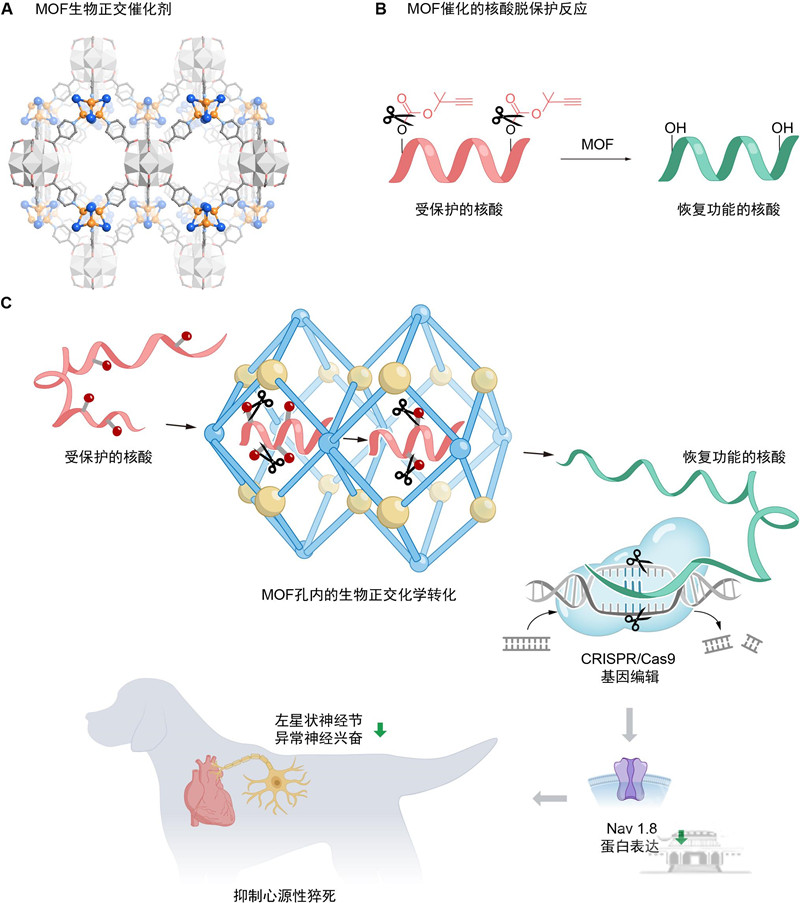
A study led by professors Deng Hexiang, Tian Tian, and Yu Lilei from Wuhan University has been published in the Journal of the American Chemical Society, revealing a novel application of metal-organic frameworks (MOFs) as bioorthogonal catalytic platforms for gene editing.
The paper, Metal-Organic Framework as a Bioorthogonal Catalyst for Gene Editing, explores the use of MOFs to facilitate bioorthogonal transformations of nucleic acids within their confined pore spaces.
The team constructed a series of Cu-MOFs with varying copper cluster configurations and pore structures and used the propargyl deprotection of RNA as a model bioorthogonal reaction to evaluate the catalytic performance of these MOFs.
The study identified three key structural parameters crucial for quantitative RNA conversion: stable Cu(I) active centers, pore sizes compatible with the substrate, and an appropriate chemical environment within the pores.
The team achieved in situ bioorthogonal activation of protected sgRNA in live cells, restoring the gene-editing function of CRISPR/Cas9. In a large animal model of acute cardiac arrhythmia, this catalytic system in situ activated sgRNA targeting SCN10A, improving arrhythmia-related electrophysiological phenotypes, demonstrating the feasibility of MOF bioorthogonal catalysis for gene editing therapy in large animals.
This work introduces bioorthogonal reactions into the well-defined crystalline pore structures of MOFs, enabling precise nucleic acid transformation and functional regulation while limiting the free release of copper ions and avoiding the introduction of exogenous reducing agents and additional ligands.
The study highlights the excellent biocompatibility of MOFs, demonstrating that their pores can accommodate biomolecules and regulate substrate recognition, chemical transformation, and product release.
 中文
中文