The latest findings from Professor Liang Yi's team at Wuhan University's College of Life Sciences, published in Advanced Science, provide new insights into the mechanisms by which Protein Disulfide Isomerase (PDI) interacts with TDP-43, a protein implicated in neurodegenerative diseases.
The study, titled Protein Disulfide Isomerase Disassembles TDP-43/G3BP1 Condensates and Antagonizes TDP-43 Pathological Aggregates, identified elevated levels of TAR DNA-binding protein 43 (TDP-43) mislocalized in the cytoplasm of brain tissue samples from two amyotrophic lateral sclerosis (ALS) patients and six Alzheimer's disease (AD) patients, compared to control samples.
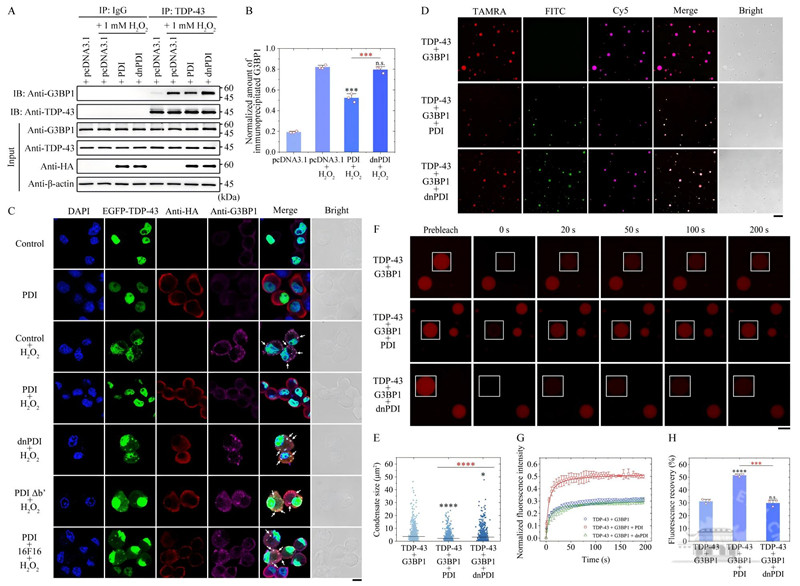
The team employed immunoprecipitation and bimolecular fluorescence complementation techniques to demonstrate a specific interaction between wild-type PDI and TDP-43 under pathological oxidative stress conditions.
Further experiments in vitro created a TDP-43 liquid-liquid phase separation system, utilizing protein fluorescence labeling, turbidity measurement, saturation concentration determination, and fluorescence recovery after photobleaching.
These experiments revealed that TDP-43 condensates recruit PDI, and the addition of wild-type PDI increases the saturation concentration for TDP-43 phase separation, reducing its tendency to phase separate and enhancing the fluidity of TDP-43 droplets.
This study is the first to discover that wild-type PDI can bind to TDP-43, regulating its phase separation process. Under pathological oxidative stress, PDI displaces G3BP1, a key component of stress granules, disassembling TDP-43/G3BP1 condensates.
 中文
中文