Professor Zhou Chen's team from the School of Earth and Space Science and Technology at Wuhan University has published their latest findings in Science Advances, utilizing a chemistry-informed artificial intelligence (AI) model to address the global data gap of stratospheric hydroxyl (OH) radicals.
The paper, A chemistry-informed deep learning network for mitigating the stratospheric OH data gap, highlights the collaborative efforts of international scholars, including Feng Wuhu from the University of Leeds, United Kingdom.
Hydroxyl radicals play a crucial role in stratospheric chemistry, driving ozone depletion and mediating the conversion of various chemical species. However, global OH observational data have been scarce, particularly after the 2009 malfunction of the Microwave Limb Sounder (MLS) subsystem, which created significant gaps in satellite observations.
To address this data deficiency, Zhou's team developed an innovative deep learning network, DRCAT, informed by chemical insights, exemplifying the immense potential of "AI for Science" in earth sciences.
DRCAT combines chemical prior knowledge with AI models to provide a feasible approach to filling the OH observational void, enhancing the understanding of stratospheric atmospheric chemistry, and offering a new tool for assessing atmospheric chemical responses during extreme disturbances.
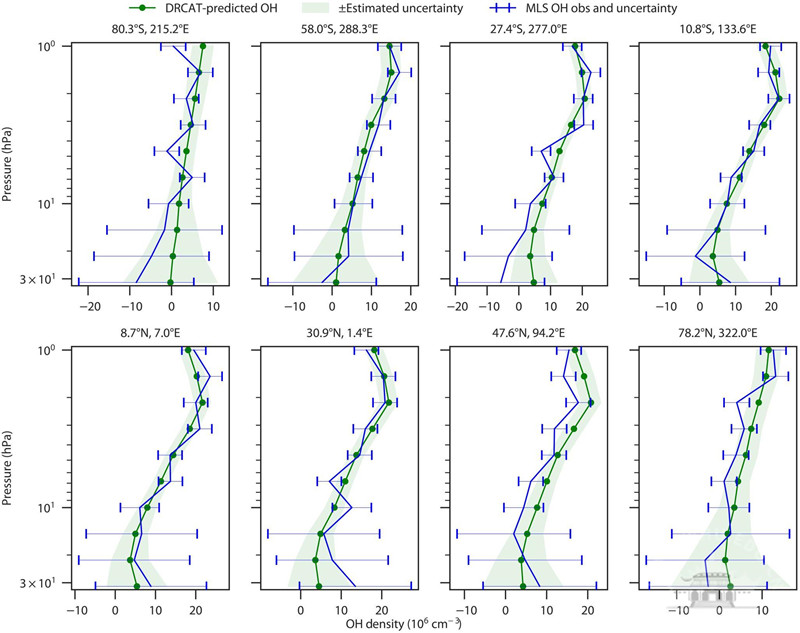
The model integrates graph neural networks with the Transformer architecture to mine satellite observation data of related chemical species and predict the vertical profiles of stratospheric OH.
Through a "pre-training-fine-tuning" paradigm, the model is pre-trained on model datasets to learn chemical rules and then fine-tuned with limited real satellite data. With only two years of actual measurement data, DRCAT reconstructed a continuous, high-precision global stratospheric OH dataset from 2004 to the present, outperforming traditional methods in all metrics.
The AI model demonstrated strong generalization capabilities in response to extreme natural events. Following the 2022 Hunga Tonga volcanic eruption — which injected a large amount of water vapor into the stratosphere, causing an unprecedented extreme water vapor disturbance and a surge in OH concentration — traditional data-driven AI models often misinterpret such extreme scenarios.
However, thanks to its chemistry-informed "pre-training-fine-tuning" mechanism, DRCAT predicted the anomalous surge in OH concentration by learning chemical rules driven by factors such as water vapor.
The scalable architecture developed in this study also provides a general AI framework for reconstructing historical data of other key short-lived atmospheric species and evaluating meteorological disasters.
 中文
中文