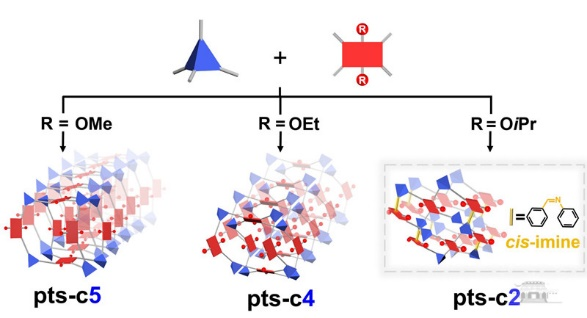
Professor Wang Cheng and his team from the College of Chemistry and Molecular Sciences at Wuhan University have published their latest findings in the Journal of the American Chemical Society, offering new insights into the structural and dynamic properties of three-dimensional covalent organic frameworks (3D COFs).
The paper, Interpenetration Control in Three-dimensional Covalent Organic Frameworks: Architectural Modulation and cis-Imine Configuration, explores controlled interpenetration in 3D COFs and the reversible cis-trans isomerization of cis-imine bonds within these structures.
Covalent organic frameworks (COFs) are crystalline porous materials composed of organic building blocks linked by covalent bonds, forming two-dimensional or three-dimensional structures. 3D COFs are promising due to their high surface area, interconnected channels, and accessible sites, making them suitable for a range of applications, including gas adsorption and separation, catalysis, and sensing.
However, the inherent free volume in 3D COFs often leads to interpenetration during crystallization, affecting their pore structure, framework flexibility, and overall functionality.
Wang's team introduced substituents of varying sizes (-OMe, -OEt, -OiPr) into geometrically identical building units, thereby constructing 3D COFs with fivefold, fourfold, and twofold interpenetrated pts topologies.
Detailed structural analysis revealed that the twofold interpenetrated 3D COF contains partially cis-configured imine bonds that undergo reversible cis-trans isomerization under external stimuli, leading to a remarkable dynamic property of approximately 220 percent expansion in unit cell volume.
 中文
中文