A team led by Professor Hou Shaocong from the School of Electrical Engineering and Automation at Wuhan University has published its latest findings, Manipulating spin dynamics via exciton–exciton interactions for bright spin light-emitting diodes, in Nature Photonics, revealing progress in high-brightness spin light-emitting diodes (LEDs).
Spin LEDs are poised to revolutionize next-generation optoelectronic devices, spin photonics, and information communication. However, their practical application has been hampered by rapid spin-flip processes at room temperature, which lead to polarization decay and information loss.
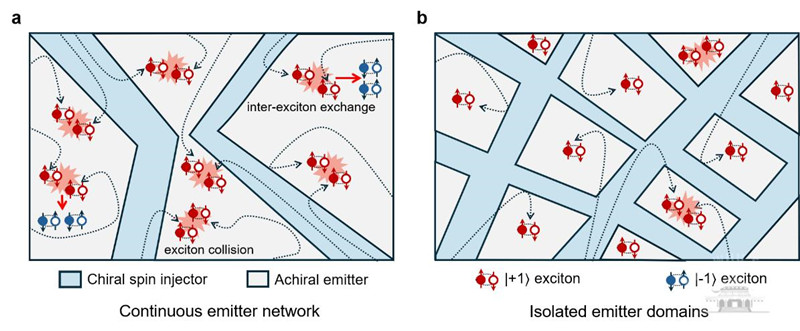
To tackle this issue, the team has developed a novel hybrid chiral metal halide heterostructure with separated luminescent units, utilizing wide-bandgap chiral spin injection materials and dividing the continuous luminescent region into multiple isolated areas.
This spatial separation reduces exciton collisions and interactions under high excitation conditions, thereby minimizing information loss during the emission process and effectively maintaining polarization.
This innovative design addresses the traditional bottleneck where balancing brightness and spin retention capabilities has been difficult in spin light-emitting devices.
The study found that this structure suppresses the rapid increase in spin-flip rates with rising excitation intensity, extending the spin relaxation time to the nanosecond range while maintaining high luminous efficiency.
The team also illuminated the dynamic mechanisms of spin information retention and loss during device operation, clarifying the impact of exciton interactions on spin retention capabilities.
The spin LED based on this heterostructure achieved a polarized electroluminescence brightness of 13,084 cd m-2 and a maximum electroluminescence asymmetry factor of 0.2.
 中文
中文