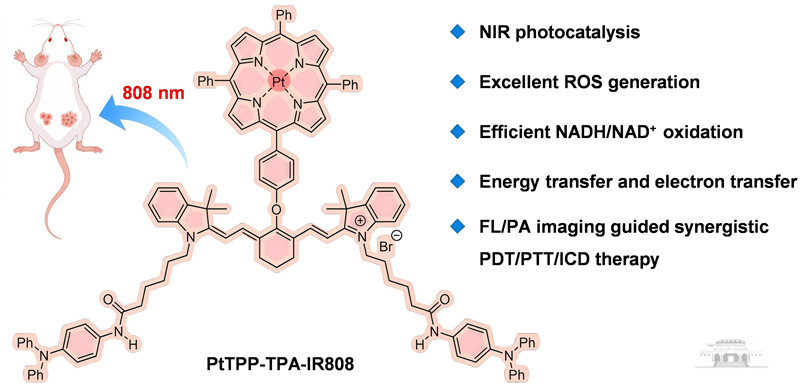
A team led by Professor Zou Youquan from Wuhan University's School of Pharmaceutical Sciences has made significant progress in near-infrared (NIR) photocatalytic synergistic cancer therapy.
Their study, Near-Infrared Light Photocatalysis Enables Synergistic Cancer Therapy, has been published in Angewandte Chemie International Edition.
Photocatalysis has long been recognized for its applications in organic synthesis, environmental remediation, and energy conversion. However, traditional photocatalysis, which relies on ultraviolet or visible light, suffers from limited tissue penetration and phototoxicity, thus restricting its potential in biomedical applications.
NIR light offers deeper tissue penetration and reduced photobiological damage, positioning it as a pivotal light source for advancing photocatalysis in biological systems. Despite its promise, the development of an efficient, biocompatible, and precisely controllable NIR photocatalytic system has remained a formidable challenge.
To overcome these obstacles, the team designed and synthesized an innovative NIR photocatalyst, PtTPP TPA IR808, by linking platinum(II) porphyrin with cyanine dye. When activated by an 808 nm laser, this molecule generates reactive oxygen species (ROS) through energy transfer (EnT) and single electron transfer (SET) pathways, disrupting the redox homeostasis of tumor cells by oxidizing the crucial metabolic coenzyme NADH.
Encapsulating this photocatalyst into biocompatible nanoparticles enables dual-mode fluorescence/photoacoustic tumor imaging and induces immunogenic cell death (ICD) in vitro.
In animal models, localized irradiation of the primary tumor activates a systemic cytotoxic T-cell immune response, inhibiting the growth of both the primary tumor and distant untreated metastatic tumors.
This innovative approach demonstrates a synergistic anti-tumor effect by integrating imaging, photocatalysis, photothermal, and immunotherapy.
 中文
中文